How to Estimate a Construction Job: A UK Step-by-Step Guide
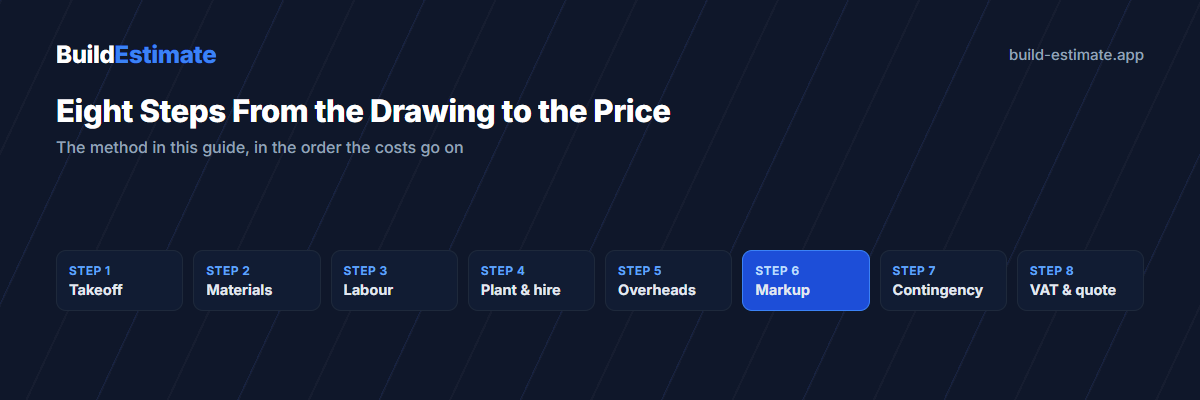
Learning how to estimate a construction job well is what separates trades that grow from those that just stay busy. This UK-focused guide walks through a repeatable method for turning a set of drawings or a customer's description into an accurate, profitable construction quote you can stand behind.
What a good estimate includes
An estimate is more than a number scribbled on the back of a job sheet. A professional estimate for tradespeople breaks the price down so you can defend it, adjust it and learn from it. At a minimum it should account for:
- Materials — everything you buy in, with an allowance for waste and offcuts.
- Labour — the hours or days needed, costed at realistic rates.
- Plant, hire and access — tools, scaffolding, skips and anything you rent.
- Overheads — the running costs of the business, spread across your work.
- Profit — added deliberately through markup, not left to chance.
- Contingency and VAT — cover for risk, plus the correct tax treatment.
Get those six things right and you have a solid framework for how to price a building job in the UK. The rest of this guide is the step-by-step method.
Step 1 — Read the job and do a takeoff
Start by understanding exactly what is being asked. Read the drawings, the specification and any client notes, and visit the site where you can. Look for the things that catch people out: access restrictions, the age and condition of the building, services in the way, and anything the client assumes is included but the drawings do not show.
Then do a takeoff — measuring the quantities of work. Count and measure every element: square metres of plasterboard, linear metres of skirting, number of sockets, cubic metres of muck away. A methodical takeoff is the foundation of the whole estimate; if the quantities are wrong, nothing downstream can be right. Work through the job in a logical order so nothing is missed, and note your assumptions as you go.
Step 2 — Price materials
With quantities in hand, apply prices. The single most important rule here is to use live supplier prices. Material costs move, and a merchant quote from six months ago can quietly wipe out your profit. Get current prices from your merchant or wholesaler for the specific job, especially on volatile items.
Always add a waste allowance. Almost nothing goes in without offcuts, breakages or over-ordering — tiling, timber and cable all generate waste, and awkward layouts generate more. The right percentage depends on the material and the job, so use your own experience rather than a blanket figure. It is also worth listing materials line by line rather than lumping them together, so you can update a single price later without rebuilding the whole estimate.
Step 3 — Cost labour
Labour is where estimates most often go wrong, because it is easy to be optimistic about how fast work goes. Break the job into tasks and estimate the time each one realistically takes, then apply your day rate or hourly rate. Think in terms of productivity: not just how long a task takes in ideal conditions, but how the actual site — access, weather, working around other trades, tea breaks and setting up — affects the pace.
Make sure your labour rate reflects the true cost of employing someone, including holiday, pensions, insurance and non-productive time, not just the take-home figure. If you are pricing your own time, pay yourself a proper rate too — your hours are a real cost even when no invoice changes hands.
Step 4 — Plant, hire, access and disposal
These are the line items that get forgotten and then eat the profit. Go through the job and ask what you will need to hire or provide beyond your standard van kit:
- Tool and plant hire — mixers, breakers, diggers, specialist tools.
- Access — scaffolding, towers, podiums or a cherry picker.
- Disposal — skips, muck away, tip charges and waste transfer.
- Site logistics — parking, permits, congestion or clean-air charges, welfare.
Even on a modest job these can add up quickly, so price them explicitly rather than hoping they come out of the margin.
Step 5 — Overheads (the costs people forget)
Overheads are the costs of simply being in business that no single job pays for on its own: your van and fuel, insurance, tools and their replacement, phone and software, accountancy, advertising, and the time you spend quoting and doing paperwork. If you never build these into your prices, you can be busy all year and still make nothing.
The usual approach is to work out your total annual overheads, then recover them across the work you expect to do — as a percentage added to each job, or as an amount per working day. Either way, every quote should carry its fair share so the business as a whole stays afloat.
Step 6 — Markup vs margin
This is the concept that trips up more tradespeople than any other, so it is worth getting straight. Markup is a percentage you add on top of your costs. Margin is your profit expressed as a percentage of the final selling price. They are not the same number, and confusing them means undercharging.
A small worked example with round, clearly illustrative numbers:
| Item | Illustrative figure |
|---|---|
| Total cost (materials + labour + overheads) | £1,000 |
| Add 25% markup | + £250 |
| Selling price | £1,250 |
| Profit as a share of the selling price (margin) | £250 ÷ £1,250 = 20% |
So a 25% markup produces only a 20% margin. If you actually want a 25% margin, you need a bigger markup — roughly a third on top of cost. The practical takeaway: decide the margin you want to keep, then work out the markup that gets you there. Never assume the two percentages are interchangeable.
Step 7 — Contingency and risk
No estimate is certain, and a contingency is your allowance for the unknowns — the rot you find behind the plaster, the ground that is worse than expected, the client change of mind. Size it to the risk in the job: a well-specified job in a modern property carries little uncertainty, while alterations to an older building, work you cannot fully inspect, or a vague brief all deserve more.
Be honest with yourself about where the risk sits, and consider noting key exclusions and assumptions on the quote so that genuinely unforeseeable work can be handled as a variation rather than swallowed. Contingency protects your margin; it is not padding to be embarrassed about.
Step 8 — VAT and presenting a professional quote
Finally, get the tax and the presentation right. If you are VAT registered, show VAT clearly and apply the correct rate — most construction work is standard-rated, but some qualifies for a reduced or zero rate, and the domestic reverse charge can apply on work between VAT-registered contractors. When in doubt, check current HMRC guidance or ask your accountant.
The document itself matters more than people think. A clear, itemised construction quote — with a scope of works, what is included and excluded, a price breakdown, payment terms and validity period — wins trust and reduces disputes. It signals that you run a proper business, and it makes it far easier to justify your price when a cheaper, vaguer quote lands next to yours.
Common estimating mistakes
- Using stale prices — quoting from old merchant figures instead of live ones.
- Under-costing labour — being optimistic about how fast the work will really go.
- Forgetting overheads — pricing only the visible costs and none of the running costs.
- Confusing markup with margin — and quietly undercharging on every job.
- No contingency — leaving nothing for the surprises every site produces.
- Vague quotes — no scope or exclusions, which invites disputes and scope creep.
- Racing to the lowest price — winning work you then lose money delivering.
How BuildEstimate speeds this up
Doing all of this by hand for every job is slow, which is exactly why so many trades cut corners on it. BuildEstimate is built to do the heavy lifting. Describe the job in plain English — or upload the drawings and let the drawing analyser read them — and the AI produces a detailed, line-item construction quote using UK 2026 material and labour prices that you can edit line by line to match your suppliers and your rates.
From there you can send the quote for online approval and e-sign, convert an accepted quote straight into an invoice, and track VAT and profit as you go. It turns an afternoon of estimating into a few minutes, while keeping you in full control of every figure.
Prefer to see the numbers first? View pricing — it is £20/month with a 7-day free trial.
FAQ
How much should I charge for a construction job?
Build the price up from cost. Add materials, labour, plant and overheads to get your total cost, then apply markup so the finished price hits the net margin you need. Avoid pricing to match a rival before you know your own costs.
What is the difference between markup and margin?
Markup is a percentage added on top of your cost. Margin is profit as a percentage of the final selling price. Because the two use different bases, a given markup always produces a smaller margin figure, so never treat the numbers as interchangeable.
How much contingency should I add to an estimate?
It depends on how much you know. A clearly specified job in a known property needs little, while alterations, older buildings or unseen ground conditions justify more. Size the contingency to the uncertainty rather than using one fixed figure for everything.
Should my quote include VAT?
If you are VAT registered, show VAT clearly and use the correct rate for the work. Some construction work qualifies for a reduced or zero rate, and the domestic reverse charge can apply between contractors. Check current HMRC guidance or your accountant for your situation.
How is an estimate different from a quote?
An estimate is your best assessment of likely cost and can move as the job is defined. A quote is a fixed price you commit to. Make clear on the document which one you are giving, and state what is included and excluded either way.