How to Write a Construction Quote (UK): What to Include + Common Mistakes
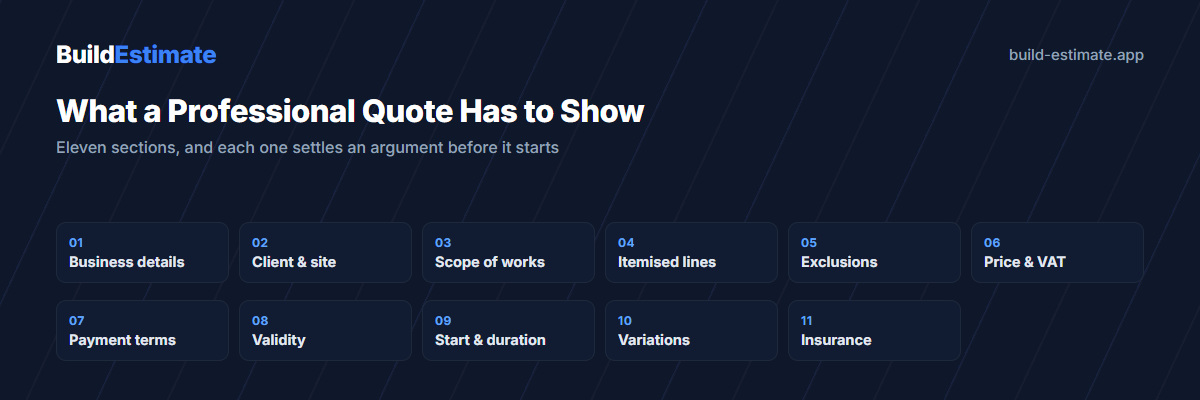
A good construction quote does two jobs at once: it wins the work, and it protects you when the job gets complicated. This UK guide covers the difference between a quote and an estimate, exactly what a professional quote should include, and the common mistakes that lose tradespeople jobs — or money.
Quote vs estimate: know which one you are sending
The two words get used interchangeably on site, but they are not the same document, and the difference matters the moment something goes wrong.
A quote is a fixed offer: you will do this defined work for this price, and the client can accept it. Once accepted, it generally forms the basis of your agreement — so everything written on it, and everything missing from it, counts. An estimate is indicative: your best assessment of likely cost, which can move as the job is defined. It is a useful early conversation, but it is not a commitment.
Three practical rules follow from that:
- Label the document clearly — put the word "Quote" or "Estimate" at the top so there is no argument later about which one you gave.
- Put it in writing — a price agreed over the phone or scribbled in a text message is an invitation for a dispute. A written quote is your record of what was agreed.
- Only quote what you can define — if the job is still vague, send an estimate first, or quote the defined part and exclude the rest until it is pinned down.
What a professional construction quote must include
A quote is not just a price — it is a description of a deal. Each section below either helps the client say yes or protects you when the job changes. Here is the full checklist:
| Quote section | What goes in it | Why it protects you |
|---|---|---|
| Business details | Trading name, address, phone, email, and company or VAT numbers where relevant | Looks professional and makes you easy to contact — and to pay |
| Client & site address | Who the quote is for and exactly where the work will happen | Ties the price to one specific property and client |
| Scope of works | The job broken into short, plain-English sections | Defines what "finished" means, so extras are visibly extras |
| Itemised materials & labour | Materials and labour as separate line items, not one lump sum | Makes the price defensible and easy to adjust if the spec changes |
| Exclusions & assumptions | What the price does not cover, and what it relies on being true | Stops unforeseen work being swallowed into a fixed price |
| Price & VAT status | The total, with VAT shown clearly or a note that you are not registered | Prevents the "I thought that included VAT" argument |
| Payment terms | When and how you get paid — including stage payments on bigger jobs | Protects your cash flow instead of leaving it to goodwill |
| Validity period | How long the price stands — for example 30 days | Stops old prices binding you after material costs move |
| Start window & duration | Roughly when you can start and how long the work should take | Sets expectations and helps the client plan around you |
| Variations clause | How changes will be priced, agreed in writing, and added | Turns scope creep into paid work instead of free work |
| Insurance details | Confirmation you hold appropriate insurance, such as public liability | Reassures the client and answers the question before it is asked |
Two of these deserve special attention, because they are the ones most often missing from losing quotes.
Scope of works in plain sections. Write the scope so the client — who is not in the trade — can read it and picture the finished job. Break it into sections ("Strip out", "First fix", "Plastering", "Decoration") with a sentence or two under each. A clear scope wins trust against a rival quote that just says "supply and fit kitchen — £X", and it is the yardstick every later disagreement gets measured against.
Exclusions and assumptions. This is the section that saves fixed-price work from disaster. Say what you have assumed ("assumes existing joists are sound", "assumes mains supply is adequate") and what is excluded ("no making good to external render", "skip permits by client"). Anything genuinely unknowable then becomes a variation to be priced when it appears — not a cost you quietly absorb.
How to price the quote
The writing side of a quote only works if the number underneath it is right. Pricing is its own discipline — takeoffs, current material prices, realistic labour rates, overheads, contingency, and the markup that actually delivers the margin you want. We have covered that whole method step by step in our guide to how to estimate a construction job, so we will not repeat it here.
The short version: build the price up from cost, never down from what you think the client will pay, and make sure every quote carries its share of overheads and profit. Then bring that itemised breakdown straight into the quote — the same materials and labour lines that built your price become the lines the client sees.
Presentation and speed win jobs
Two quotes with the same price do not have the same chance of winning. Presentation and turnaround decide more work than most tradespeople realise.
- Respond fast. Clients usually gather more than one price, and the first professional quote through the door frames the decision. A quote that arrives days late is often quoting for a job that has already been given away.
- Send a PDF, not a text message. A figure in a WhatsApp message reads like a guess. A properly laid-out PDF with your business details, an itemised breakdown and clear terms reads like a business the client can trust with their house.
- Follow up. A short, polite message a few days later — "any questions on the quote?" — costs nothing and regularly rescues jobs that were drifting. Silence is not always a no; sometimes it is just a busy client.
Common quoting mistakes
- Vague scope — "renovate bathroom" tells the client nothing and gives you nothing to point at when they expected more.
- No exclusions — a fixed price with no stated limits quietly makes every surprise your problem.
- Forgetting VAT — an unclear VAT position either costs you the VAT or costs you the client's trust at invoice time.
- No validity date — an open-ended quote can bind you to last season's material prices.
- Underpricing variations — pricing changes casually mid-job, without writing them down, is how profitable jobs end up break-even.
- Slow turnaround — taking a week to quote hands the job to whoever quoted in a day.
How BuildEstimate speeds this up
Everything above takes time to do properly — and time is exactly what most trades do not have at the end of a working day. BuildEstimate is a UK-focused, AI-assisted quoting app that builds itemised estimates with materials and labour and turns them into professional quotes fast, from your phone or your desktop. Instead of typing up a document at 9pm, you get a clear, itemised quote ready to send while the enquiry is still warm — and you stay in control of every line.
You can use it as a web app at build-estimate.app, and it is also available on the App Store and Google Play.
Prefer to see the numbers first? View pricing — it is £20/month with a 7-day free trial.
FAQ
What is the difference between a quote and an estimate in construction?
A quote is a fixed offer to do defined work for a stated price, which the client can accept. An estimate is an indication of likely cost that can move as the job is defined. Label the document clearly and put either one in writing.
Is a construction quote legally binding in the UK?
In general, once a client accepts a quote it forms the basis of the agreement between you, which is why the scope, exclusions and validity period matter so much. Keep everything in writing and seek professional advice for anything contractual you are unsure about.
How long should a construction quote be valid for?
State a validity period on every quote — 30 days is a common choice. Material and labour prices move, so an open-ended quote can commit you to old prices months later. After the validity date, re-check your costs before honouring the figure.
Should I show VAT on a construction quote?
If you are VAT registered, make the VAT treatment clear — show whether the price includes or excludes VAT and at what rate. If you are not registered, say so. Check current HMRC guidance on gov.uk or ask your accountant for your specific situation.
What should a construction quote include?
Your business and contact details, the client and site address, a plain-English scope of works, itemised materials and labour, exclusions and assumptions, the price with VAT status, payment terms, a validity period, a start window and duration, a variations clause and your insurance details.