The 14-Day Cooling-Off Period on a Quote Signed at Home
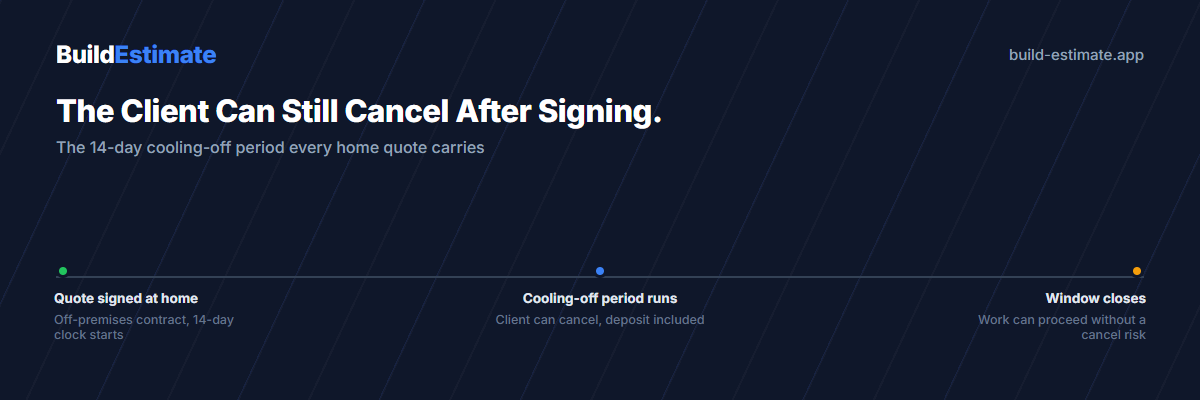
You sit at the kitchen table, walk the client through the quote, they sign, you take a deposit, and the skip gets ordered for Monday. As far as you're concerned the job's on. Legally, for the next 14 days, the client can cancel the whole thing and get their deposit back. If you didn't tell them that in writing before they signed, the 14 days can stretch to nearly a year.
This isn't a loophole for difficult clients. It's the Consumer Contracts (Information, Cancellation and Additional Charges) Regulations 2013, and it applies to a large share of the domestic quotes a small trades business signs off outside an office: extensions, kitchen refits, rewires, roofs, driveways, anything agreed at the client's home rather than at yours. None of the fourteen guides already on this site touch it. It sits underneath every one of them.
What makes a contract "off-premises" (and what doesn't)
The Regulations use the term off-premises contract for a deal agreed somewhere other than the trader's business premises, with both parties physically there together. A kitchen table, a driveway, the back of your van parked outside: all off-premises. A contract concluded at your own office or showroom isn't, and neither, generally, is one where you leave a written quote and the client thinks it over and confirms later by phone without you present for that step. The distinction that matters is whether you were both there when they actually said yes.
Quote by phone or by email, with no visit involved at all, and you're in a related but separate category: a distance contract. The 14-day cancellation right still applies; only the information rules around it shift slightly. Very little domestic trade work is agreed that way, but it's worth knowing the label doesn't disappear just because nobody stood in the kitchen.
The 14 days, and when the clock actually starts
For a job that's purely labour (a rewire, a plastering job, anything with no goods handed over), the 14 days runs from the day after the contract is agreed. Where the job includes goods as well as the fitting of them, a new kitchen, a boiler, a set of windows, the clock instead starts the day after the last of those goods physically reaches the client. Regulation 30 sets both versions out, and the second one is easy to miss: a supply-and-fit contract's cancellation window can start weeks after the quote was signed, once the units finally turn up.
What you have to tell them before they sign
Regulation 10 lists what a client is owed before an off-premises contract is made: who you are and how to reach you, the total price including VAT, how and when you'll be paid, and the part most quote packs skip, the conditions, time limits and procedure for cancelling, plus a completed cancellation form they can use if they want to. It has to be given on paper, or by another durable medium if the client's happy with that, meaning a printed contract pack or a proper PDF, not a verbal mention while you're packing up the van.
Most trade contract templates already have a slot for this. The habit that's easy to drop is actually filling it in and handing it over before the pen comes out, rather than after.
Skip it, and the window doesn't stay at 14 days
Miss the cancellation information and the clock doesn't just keep running quietly in the background. Regulation 31 extends it: if you give the missing information later, the client then has a further 14 days from that point to cancel; if you never give it, the right runs for a full 12 months past when the normal 14 days would have ended. A job finished, paid and long forgotten can, on paper, still be cancelled by a client who was genuinely never told they had the right. That's not a likely outcome on a happy job, but it's a real one on a job that later goes sour for an unrelated reason and the client goes looking for a way out.
Starting work inside the 14 days
Plenty of jobs can't wait a fortnight, and the Regulations allow for that, with one condition. To start work before the 14 days are up, Regulation 36 requires an express request from the client on a durable medium: a signature on the form, a text, an email, not just a nod when you ask if it's alright to crack on Monday. Get that, and if the client later cancels anyway, they owe you a proportionate amount for the work actually done up to the point you're told, worked out against the total contract price. Skip it, start because the skip's already booked or the plaster needs to go off before the weekend, and a cancellation after the fact means the client owes nothing at all, materials already bought included.
A one-line "start work now" acknowledgement, signed or emailed alongside the quote, closes this off in about thirty seconds. Most of the trade contract packages that already generate a quote can generate this at the same time.
The £170 urgent repair exception, and what it doesn't cover
Two separate provisions get run together here, and they're not the same thing. Regulation 11 lets you give a shorter set of information, rather than the full list, for an off-premises repair or maintenance contract the client specifically asked for, carried out immediately, where the price doesn't go over £170: a same-day tap or lock repair, broadly. That's a reduced paperwork rule, not a removal of cancellation rights.
Regulation 28 is the one that actually removes the cancellation right, and it's narrower still: it only applies where the client explicitly asked for an urgent repair or maintenance visit and the trader carried it out there and then. It covers that specific repair and nothing else sold on the same visit. Call out for a burst pipe and also sell a new boiler while you're there, and the boiler isn't covered by the exemption, whatever the price of the callout was.
| Provision | What it does | Trigger |
|---|---|---|
| Regulation 11 | Reduced information only, not a cancellation exemption | Requested repair/maintenance, done immediately, price ≤ £170 |
| Regulation 28 | Removes the cancellation right for that specific job | Requested urgent repair/maintenance, carried out immediately, any price |
New builds and extensions: the one exclusion that actually matters
The Regulations exclude the construction of new buildings outright, and substantially new buildings created by converting an existing one. They do not exclude extensions to a building that's already standing. A loft conversion, a rear extension, a kitchen refit, a rewire, a re-roof on an existing house: all inside the Regulations. A genuine new-build self-build contract, or a barn conversion extensive enough to count as a new building, sits outside them. Most of what a small building firm quotes for a homeowner is the former, not the latter.
Building it into the quote
None of this changes how you price a job. It changes what leaves your hand alongside the quote, and when you're allowed to put a spade in the ground.
- Give the cancellation information in writing before the client signs, not after: a printed slip or a PDF, with a cancellation form included.
- If the start date is inside the 14 days, get a written "go ahead now" request before ordering materials against it, not a verbal yes on the doorstep.
- Know which of the three regimes a job sits in, ordinary off-premises quote, urgent repair under £170, or genuinely excluded new build, before assuming a deposit is safe to spend.
BuildEstimate won't draft your cancellation notice or chase a signature on it. It will let you attach the cancellation information and a start-date acknowledgement to a quote as a standard part of sending it, so the paperwork exists before the deposit does, rather than being reconstructed after a client asks for their money back. See our guides on writing a construction quote and getting paid on time for the rest of a job's paperwork done properly.
Prefer to see the numbers first? View pricing: it is £20 per month or £220 a year, with a 7-day free trial and no card required to start.
FAQ
Does this apply if I quote by phone or email and never actually visit before they agree?
Yes, just under a different label. A contract agreed without you and the client in the same place at the same time is a distance contract rather than an off-premises one, but the Consumer Contracts Regulations 2013 give a consumer the same 14-day right to cancel either way. The one combination that mostly avoids this regime is a written quote left on the table that the client thinks over and confirms later by phone, with nobody pressuring a signature there and then. Even that is a fine distinction worth getting right rather than assumed.
Do I have to use the government's model cancellation form, or can I write my own?
You have to give the client a completed model cancellation form, or one that covers the same ground, before the contract is made; it's one of the specific pieces of information Regulation 10 requires. Plenty of trade contract templates build it in as a tear-off slip or a final page. What you can't do is skip it because the client seems happy and it feels like paperwork for its own sake; it's the one part of this that's checked first if a cancellation turns into a dispute.
What actually happens if I just don't mention any of this?
The 14-day clock doesn't start running properly. Regulation 31 extends the cancellation period to 14 days after you finally give the missing information, or 12 months after the normal period would have ended if you never do, whichever comes first. In practice that means a job finished and paid for six months ago can still, technically, be cancelled by a client who was never told they had the right, which is a bigger exposure than most tradespeople realise they're carrying.
Can a client still cancel after I've started the job, if they asked me to start early?
Yes, cancelling stays their right for the full 14 days regardless. What changes is what they owe you. If they gave an express request on a durable medium (signed, texted or emailed, not just said out loud) to start before the 14 days are up, and then cancel, they owe a proportionate amount for the work actually done. If you started without that request, because the skip was booked or the plaster needed to go off before the weekend, and they cancel, they owe nothing at all, whatever materials you've already bought.
Does the £170 rule mean any repair under £170 has no cancellation rights?
No, and this is the distinction that catches people out. The £170 threshold in Regulation 11 only reduces the information you have to hand over; it doesn't remove the cancellation right by itself. A separate, narrower exemption in Regulation 28 removes the cancellation right entirely, but only where the client specifically asked for an urgent repair or maintenance visit and you carried it out immediately: a burst pipe call-out, not a kitchen refit quoted at £150 that starts next month. And it only covers the urgent work itself: sell a new boiler on the same visit and the boiler isn't covered by the exemption.
Is a loft conversion an extension or a new building for this purpose?
An extension. The Regulations exclude the construction of new buildings, and of substantially new buildings created by converting an existing one, but they cover extensions to a building that already exists. A loft conversion, a rear extension, a kitchen refit, a rewire or a re-roof on an existing house all sit inside the Regulations. Only genuine new-build work, or a conversion so extensive it amounts to a new building, sits outside them.
Does this apply to commercial clients, or just homeowners?
Just consumers: someone acting wholly or mainly outside their trade, business, craft or profession. A homeowner having an extension built is a consumer. A landlord instructing work through their letting company, or a shop fitting out its own premises, generally isn't, and the Consumer Contracts Regulations don't apply to that contract at all. Mixed cases exist, a sole trader having work done partly for the business, partly for the home, and where it's genuinely unclear, the safer assumption is that consumer protection applies.
None of this is a reason to stop signing jobs at the kitchen table. Most clients never cancel, and the ones who do usually would have found a way out regardless. It is a reason to hand over the cancellation form before the pen comes out, and get the "start now" request in writing when the timeline's tight. Both take less time than the conversation that follows if you skip them and a job goes wrong for some other reason entirely.