When to Walk Away From a Job (And How to Say No)
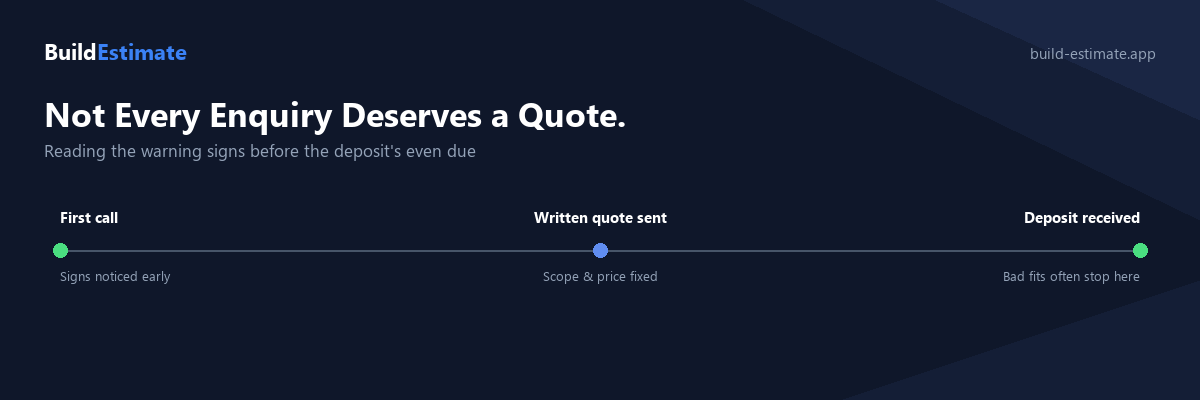
The phone call runs eleven minutes. Somewhere around minute seven the client mentions he'd rather "sort the money side once he's seen a bit of progress." You've heard that line before, usually right before the job that took three chasing emails to get paid for. Not every hesitant client is a problem client. Some genuinely haven't priced a job like this before and don't know what's normal. The skill worth building is telling the two apart before you've cut a single length of timber. By the time you're three days in, walking away costs a lot more than saying no ever would have.
The red flags that show up before you've priced anything
Some warning signs turn up in the first conversation, long before you've picked up a tape measure. A brief that stays vague no matter how many questions you ask ("just make it nice, you're the expert") isn't flattery. It's a job where the client hasn't decided what they actually want. You'll be the one absorbing the cost of that indecision once you're on site, not them.
Listen for how someone talks about previous tradespeople too. Everyone's had one bad experience with a cowboy at some point. That's not unusual. It's a different thing when someone mentions three or four in a row, each one apparently useless, each one somehow entirely at fault. Maybe that's exactly what happened. It's also, on the numbers, unlikely that four separate professionals in a row were all incompetent and the common factor in the room wasn't them.
Pressure to start before anything's agreed in writing is another one. "Can you just pop round Monday and crack on, we'll sort the paperwork after" sounds like trust. It's actually a job with no agreed scope, no agreed price and no agreed payment terms. Any dispute later has nothing written down to settle it. Our guide on writing a construction quote covers what a proper one should actually pin down before you pick up a tool.
Red flags that show up while you're still quoting
Other warning signs only surface once you've started putting numbers together. Scope creep before you've even started work is the big one. If the ask has grown twice already during the quoting stage, with no acknowledgement that a bigger job costs more, it will keep growing once you're on site and committed to being there. Our guide on pricing variations covers how to handle scope changes once a job's under way, but the same instinct applies before you've even started: price the addition, don't fold it in quietly.
A budget that's clearly nowhere near the job is worth naming early rather than working around quietly. A full rewire of a four-bedroom house priced against a stated budget of £1,500 isn't a pricing challenge to solve with a smaller margin. It's a conversation to have out loud, before you spend an evening building a detailed quote nobody was ever going to accept.
This is where pricing the job properly earns its keep, not just as admin but as information. Line items instead of one headline figure show the client exactly where the money's going, and that's usually the moment a mismatched budget becomes visible to both sides, not just to you. Breaking a job into its actual line items rather than one number does this automatically, because a budget gap is much harder to hide inside a list the client can see than inside a single lump sum handed over at the end of a phone call.
| Signal | What it usually means | What to do |
|---|---|---|
| Won't commit a deposit after agreeing the price | Preview of how the rest of the invoices will go | Hold the line on deposit terms, or step back |
| Brief stays vague after you've asked questions | Client hasn't decided what they want yet | Get it written down before quoting further |
| Budget well below the realistic figure | Mismatch worth naming, not absorbing | State the real number once, let them decide |
| Scope grows before work has even started | Preview of scope creep once you're on site | Price each addition separately, in writing |
Trust the read from the first call
Some of this isn't a checklist item. It's pattern recognition built over years on the tools. A conversation that feels off, before you can even say exactly why, is worth listening to. Trades who've been doing this for a decade or more will often say the same thing: the job that went wrong was rarely a surprise by the end, because there'd been a feeling about it from the first phone call that they talked themselves out of.
That's not an argument for turning down every client who's a bit awkward on the phone. Plenty of perfectly good clients are just not natural on the phone, or nervous about spending money on something big, and neither of those is a red flag on its own. It is an argument for not overriding a strong gut feeling just because you need the work this month.
The three-sentence decline that works most of the time
- Say no plainly, first. Don't bury it under three paragraphs of context — lead with the decision, not the reasoning.
- Give one honest reason, not a report. A sentence is plenty. A full case for the defence just invites a negotiation you don't want to have.
- Leave the door open if you mean it. If you'd take their next job, say so directly. Don't assume they'll assume it.
Once you've decided, keep the decline short. "This one isn't the right fit for us at the moment, but thanks for thinking of us" does the job in a single sentence. Trades who over-explain a decline often end up talking themselves back into the job halfway through the explanation.
You don't owe anyone a detailed breakdown of why. A brief, honest reason, something like "the scope and the budget don't line up for us," is enough on its own. If you genuinely have someone to point them toward, do it. It costs you nothing, and it's the kind of thing that gets remembered and repaid later, often on a job you actually wanted.
With a regular or repeat client, separate the job from the relationship out loud. "I can't take this one on, but come back to me for the next one" tells them clearly that you're turning down this job, not them. Most clients worth keeping remember that you were straight with them far longer than they remember which specific job you didn't take.
Stepping back once you've already started
Occasionally the decision comes after you've already started, and that's harder. A missed deposit payment, working conditions that aren't safe, or a scope that keeps expanding without ever being agreed in writing are all legitimate reasons to stop. Invoice for whatever's genuinely complete. Document what happened while it's fresh. Check your own terms before you down tools, because what you're entitled to at that point usually depends on what you both agreed at the start, not on how unfair the situation feels right now. If a client's dragging their feet on the invoices for work you've already done, our guide on getting paid on time covers the escalation steps before it gets to that point.
Where BuildEstimate fits in
BuildEstimate won't have the difficult phone call for you, and it won't tell you which client is worth the risk. What it does is make pricing a job properly fast enough that you can afford to do it for every enquiry, not just the ones that already feel safe, and that's exactly the point at which most of these red flags become visible instead of theoretical. An itemised quote with a stated deposit and staged payments does more filtering in five minutes than a week of wondering ever will.
Prefer to see the numbers first? View pricing — it is £20 per month or £220 a year, with a 7-day free trial and no card required to start. If deciding what to quote for is only half the battle, our guides on writing a construction quote and estimating a job cover the rest of it.
FAQ
What's the single clearest red flag before you've even started pricing?
Reluctance to commit money once you've agreed a figure and a date. A vague brief or a shifting scope is worth weighing up, but a flat refusal to put down a deposit after saying yes to the price is usually the clearest signal you'll get, because it tells you how the rest of the job's payments are likely to go too.
How do I turn a job down without sounding difficult to work with?
Keep it short, factual, and don't dress it up as something it isn't. "This one isn't the right fit for us at the moment, but thanks for thinking of us" does the job in one sentence. Trades who over-explain a decline often end up arguing themselves into taking the job anyway.
Should I give a client a reason when I decline?
A brief one is fine and often appreciated. A detailed one usually isn't necessary and can invite an argument. "The scope and budget don't line up for us" is honest without being a debate starter, and you don't owe anyone a full breakdown of why you've made the call.
Is it ever right to walk away once work has actually started?
Yes, though it should be rare and it's a bigger step than declining at the quote stage. Non-payment of an agreed stage, unsafe working conditions, or a client who keeps expanding the scope without agreeing it in writing are all legitimate reasons. Invoice for everything genuinely completed, document what happened, and check your own terms before you down tools.
What if the client's budget genuinely doesn't match what the job needs?
Tell them the real number, once, clearly, and let them decide. Some will find the extra money or agree to a reduced scope that actually fits the figure they had in mind. Others go quiet, which is your answer without you having to say no directly.
Should I still send a full written quote for a job I suspect I'll turn down?
If you've genuinely decided not to do it, don't bother — a written quote takes real time to put together properly, and that time is better spent on work you'll actually win. If you're still on the fence, sending a clear, itemised quote with a deposit due date is often the fastest way to find out whether the doubts were justified.
How do I say no to a regular client without losing their future work?
Separate the job from the relationship, explicitly, in what you say. "I can't take this one on right now, but come back to me for the next one" tells a good client you're not walking away from them, just from this particular job. Most reasonable clients remember that you were straight with them, not that you turned down one specific job.
Does asking for a deposit put off genuine clients?
Rarely. Clients who intend to pay for the whole job tend not to blink at paying a fraction of it upfront, especially once it's normal practice explained on the quote rather than sprung on them afterwards. The clients who push back hardest on a deposit are disproportionately the ones who were going to be difficult about the final invoice too.
Not every awkward client is a bad one, and not every job that feels wrong turns out that way. But the ones that do almost always gave you a chance to notice, usually more than once, before you were in too deep to walk away cheaply.