How to Get Paid On Time as a UK Tradesperson
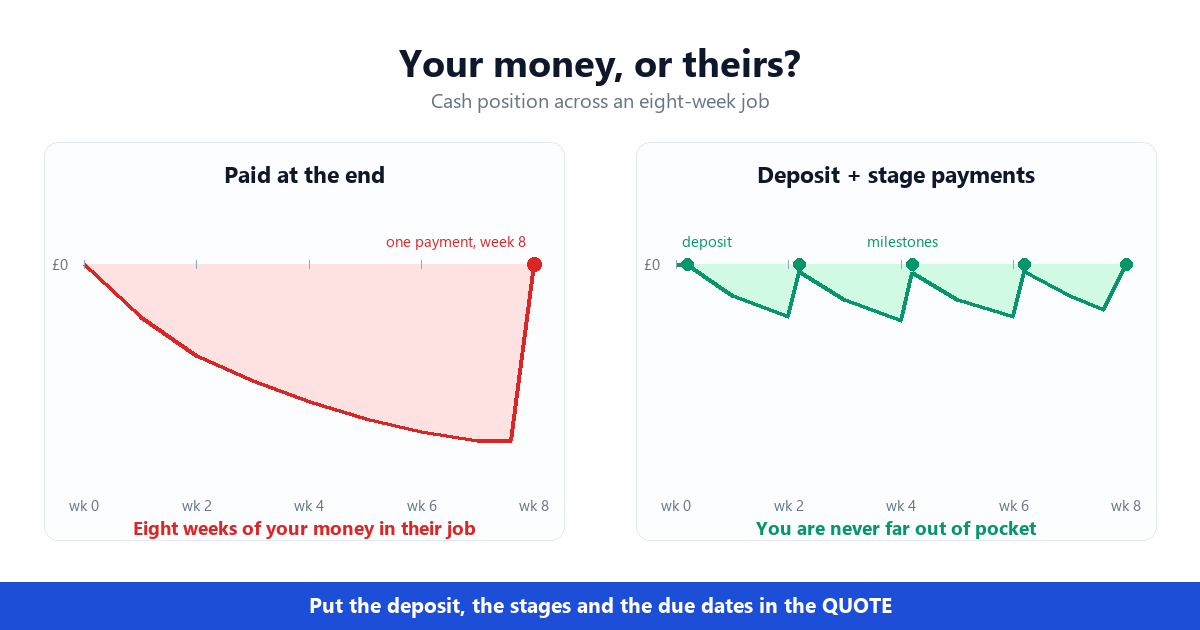
Most trades who have cash-flow trouble are not underpriced and are not badly run. They are funding their customers' jobs out of their own bank account and calling it normal. Materials go on the card in week one, wages go out every Friday, and the money for all of it turns up somewhere after the job finishes — if the customer is prompt. This guide is about closing that gap: what to take up front, how to stage the rest, when to invoice, how to chase without souring the relationship, and what the law actually gives you when someone will not pay.
The problem is the terms, not the chasing
Chasing is a symptom. If you find yourself sending third reminders every month, the fix almost never lies in writing a better reminder — it lies in what was agreed before anyone picked up a tool.
Three things determine whether you get paid on time, and all three are decided at quote stage:
- How much of your own money is in the job at any moment. That is set by the deposit and the payment stages.
- Whether the customer knows exactly when each payment is due. That is set by the terms in the quote.
- Whether there is anything to argue about. That is set by how clearly your scope, your variations and your milestones were written down.
Get those right and chasing becomes rare. Get them wrong and no amount of politeness at the back end will rescue it.
Step 1: Take a deposit that covers your exposure
The useful question is not "what percentage do people normally ask for?" It is: what do I have to spend before I can invoice anything?
On a job with a big materials order — a kitchen, windows, a roof — that number can be most of the first month's outlay. On a labour-heavy job it may be small. Set the deposit against the real figure rather than a habit.
Two practical points. First, explain what it is for. Customers are generally comfortable paying for materials and understandably reluctant to pay for labour that has not happened yet, so "this covers the materials order, which I have to place before I start" lands very differently from "I need 50% up front". Second, be aware that unusually large deposits on small domestic jobs are a well-known warning sign to consumers, and asking for one can cost you the job even when your reasons are perfectly sound.
Step 2: Stage the rest against visible milestones
Anything longer than about a fortnight should be staged. The critical detail is what you tie the stages to.
Tie them to events the customer can see with their own eyes — first fix complete, plastering done, second fix complete, snagging signed off. A milestone the customer can verify is very hard to argue with. Tie them to dates instead, and every weather delay becomes a payment dispute. Tie them to "50% at halfway" and you have invited a debate about what halfway means.
| Stage basis | How it holds up |
|---|---|
| Visible milestone (first fix done, plaster on) | Strong — the customer can check it themselves |
| Named calendar dates | Weak — any delay, including the customer's own, becomes an argument |
| Percentage of time elapsed | Weak — nobody agrees where the halfway point is |
| Materials delivered to site | Strong for supply-heavy jobs, and easy to evidence with a delivery note |
Keep a genuine final payment at the end — enough that finishing properly matters, small enough that you are not carrying the job. The mistake in both directions is common: a final payment so large that the last fortnight is unfunded, or so small that snagging never gets done.
Step 3: Put the terms in the quote, not the invoice
This is the single highest-value change most trades can make, and it costs nothing.
The quote is the document the customer accepts. That acceptance is what makes the terms binding. Terms that appear for the first time on the invoice were never agreed to, and if the payment is ever disputed they are worth very little.
Your quote should state, in plain words:
- the deposit and what triggers it
- each payment stage and the milestone that releases it
- how many days each payment is due within
- how to pay — bank details, and whether card is accepted
- what happens if payment is late, including interest if you intend to charge it
- what is not included, so extras are recognisable as extras
That last line does more for your cash flow than it looks like it should. Most payment disputes are really scope disputes wearing a different hat — the customer is not refusing to pay, they are refusing to pay for something they did not think they had asked for. A clear exclusions list at quote stage prevents that argument from ever forming. Our guide to writing a construction quote covers the wording in detail.
Step 4: Invoice the day the stage completes
Payment terms run from the invoice. Every day between the milestone and the invoice is a day you have added to your own wait, for free.
The habit worth building is invoicing from site the moment a stage is signed off, rather than accumulating paperwork for Sunday evening. A week's delay on a 14-day invoice is not a 7-day slip — it is a 50% increase in how long you wait for that money.
Make sure the invoice itself does not create a reason to delay: the customer's correct name and address, a reference to the job, a clear description of the stage completed, the amount, the due date as a date rather than "14 days", your bank details, and your VAT number if you are registered. An invoice with a vague description is an invoice that sits in someone's pile while they work out what it is for.
Step 5: Chase on a schedule, not on a mood
Decide the routine once, then apply it to everyone without re-deciding. It removes the awkwardness, and it means the good customers are not subsidising your reluctance to chase the bad ones.
A routine that works for most domestic and small commercial work:
- Two days before due — a short, friendly note. "Invoice 104 is due Thursday, here are the bank details again." An enormous share of late payment is simply forgetting, and this one message prevents most of it.
- Day one past due — a brief factual note that it is now overdue, with the invoice attached again.
- Day seven — a phone call. Not an email. Almost every genuine problem, from a dispute to a cash-flow difficulty at their end, surfaces on the phone and stays invisible over email.
- Day fourteen — written notice that late-payment terms now apply, and that the matter will be escalated if it is not settled by a stated date.
- Day thirty — formal letter before action.
Keep every step in writing, and keep it unemotional. If this ever ends up in front of a judge, a calm and consistent paper trail is worth a great deal, and a frustrated one is not.
What the law actually gives you
This is where most guidance for trades goes wrong, because it quotes rules for commercial contracts at people doing kitchens for homeowners. Your rights differ substantially depending on who the customer is, so establish that first.
| Business customer (B2B) | Domestic customer (residential occupier) | |
|---|---|---|
| Statutory interest on late payment | Yes — Bank of England base rate + 8% under the Late Payment of Commercial Debts (Interest) Act 1998, even if the contract is silent | No — only if your agreed terms provide for it, and the term must be fair under consumer law |
| Fixed compensation per invoice | Yes — £40 under £1,000, £70 from £1,000 to £9,999.99, £100 at £10,000 and above | No statutory entitlement |
| Default payment period if nothing agreed | 30 days from the later of receipt of the invoice or completion of the work | Governed by your contract; agree it explicitly |
| Statutory right to stage payments | Yes under the Construction Act, where the work is not specified to last under 45 days | Excluded by section 106 — stage payments only if your quote says so |
| Right to suspend work for non-payment | Yes under the Construction Act, after the required written notice | Not automatically — depends on your contract terms |
| Right to adjudication | Yes | Excluded, unless the contract itself provides for it |
Two things follow from that table, and they are the practical heart of this article.
On commercial work, you have more rights than you probably use. Statutory interest and fixed compensation apply automatically to B2B debts — you do not need a clause, and the amounts are not trivial across several invoices. Many trades never mention them. Simply referring to your statutory entitlement in a chasing letter changes the tone of the conversation with a slow-paying commercial client, and it is not an aggressive thing to do.
On domestic work, you have fewer, so the paperwork carries the weight. The Construction Act's protections — stage payments, suspension, adjudication — are specifically excluded for residential occupiers under section 106. Nothing gives you a right to stage payments on a homeowner's extension except the quote they accepted. That is exactly why Step 3 matters so much: on domestic jobs, your terms are your protection.
When the routine runs out
If chasing has failed, the next step is a letter before action: what is owed, what it relates to, what has already been requested, and a clear deadline to respond. Where the debtor is an individual or a sole trader, the Pre-Action Protocol for Debt Claims sets out particular information you have to include and gives them 30 days to reply. Follow it — courts can penalise a claimant who skipped it, and in practice a properly drafted letter before action settles a good share of disputes without a claim being issued at all.
Beyond that, small money claims can be started online, with the small claims track in England and Wales generally handling straightforward claims up to £10,000. It is designed to be usable without a solicitor. Before you go there, be honest with yourself about two things: whether your paperwork actually supports the claim, and whether the customer has any money to pay it. A judgment against someone with nothing is an expensive piece of paper.
How BuildEstimate helps
BuildEstimate is a UK-focused, AI-assisted quoting app that turns materials and labour into itemised estimates and professional quotes — on your phone on site, or at a desk. Its role in getting paid is at the front end, where the outcome is actually decided: the quote that carries your deposit, your payment stages, your due periods and your exclusions is the same quote you send to win the work. Terms that are part of your standard quote get agreed as a matter of course, and terms you have to remember to add are the ones that go missing on the busy weeks.
A clear itemised scope also does the quieter job of preventing the disputes that stall payment in the first place — when the customer can see exactly what was priced, the "I thought that was included" conversation mostly does not happen.
You can use it as a web app at build-estimate.app, and it is also available on the App Store and Google Play.
Prefer to see the numbers first? View pricing — it is £20/month with a 7-day free trial. If your margins feel tight even when customers pay promptly, it is worth checking margin vs markup and how to set your day rate.
FAQ
How much deposit should a builder ask for?
Base it on what you have to spend before you can invoice anything, rather than on a habit or a round percentage. If a job needs a large materials order up front, the deposit should cover it — you should not be buying a customer's materials with your own money and waiting weeks to be reimbursed. Very large deposits on small domestic jobs make customers nervous, so explain what the money is for. Most people are comfortable paying for materials and reluctant to pay for labour that has not happened yet.
Can I charge interest on a late invoice?
It depends who the customer is. For business-to-business work, the Late Payment of Commercial Debts (Interest) Act 1998 gives you a statutory right to interest at the Bank of England base rate plus 8%, plus fixed compensation of £40, £70 or £100 depending on the size of the debt — even if your contract says nothing about it. For a domestic customer that Act does not apply, so you can only charge interest if your agreed terms provide for it and the term is fair under consumer law.
When is an invoice legally overdue in the UK?
Whenever your agreed terms say it is. If nothing was agreed on a B2B contract, the default under the late payment legislation is 30 days from the later of the customer receiving the invoice or the work being completed. Longer terms can be agreed, but anything beyond 60 days must not be grossly unfair to the supplier.
Do stage payments apply to domestic work?
Only by agreement. The statutory right comes from the Construction Act, and section 106 excludes contracts with a residential occupier — someone having work done on the home they live in or intend to live in. On domestic work, stage payments exist because they are in your quote and were accepted, not because the law provides them. That makes writing them into the quote more important, not less.
Can I stop work if I have not been paid?
On commercial contracts covered by the Construction Act there is a statutory right to suspend performance for non-payment, provided you give the required written notice first. On domestic work that right does not apply, so your position depends entirely on your contract. Walking off site without a contractual right to do so can put you in breach — check your terms and take advice before suspending.
What should I do before taking someone to court over an unpaid invoice?
Send a formal letter before action setting out what is owed, what it relates to and a deadline to respond. Where the debtor is an individual or a sole trader, the Pre-Action Protocol for Debt Claims specifies what you must include and gives them 30 days to reply. Following it properly matters — courts can penalise a claimant who skipped it, and a well-drafted letter before action resolves a large share of disputes on its own.
The honest version
You cannot make every customer pay on time. What you can do is make sure that when one does not, you are not carrying six weeks of their materials and wages while you find out.
Deposit sized to your actual exposure, stages tied to things the customer can see, terms in the quote rather than the invoice, invoice the same day, chase to a fixed routine. None of it is clever, and all of it is decided before the job starts — which is the entire point.