The VAT Reverse Charge for Construction, Explained
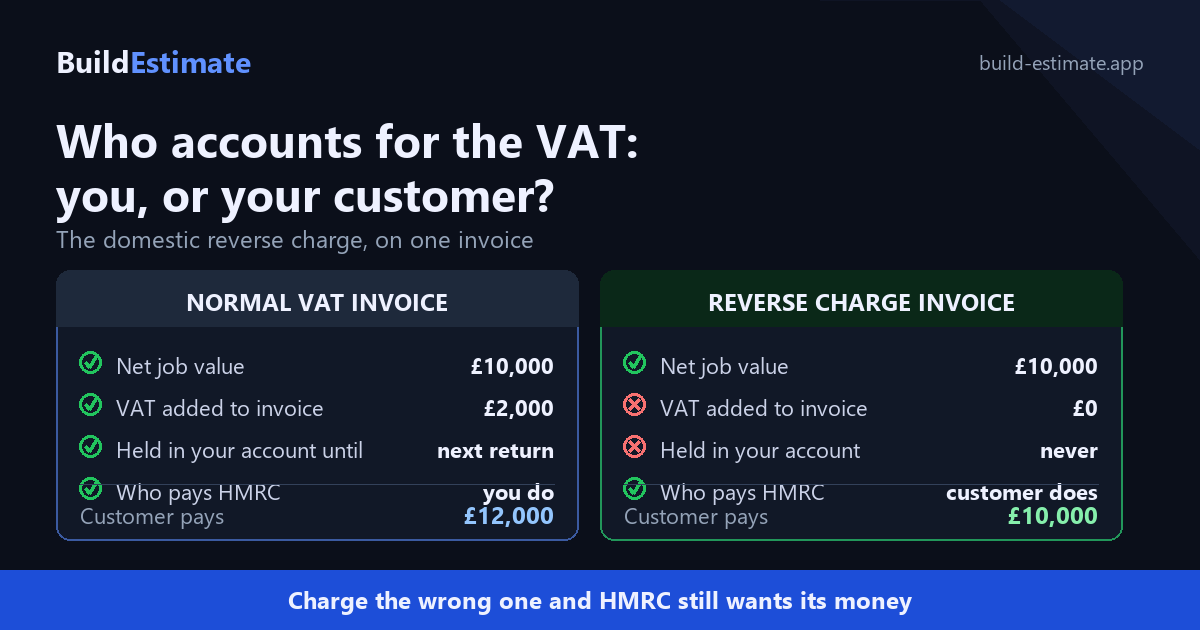
Most subcontractors first meet the VAT domestic reverse charge the hard way: a contractor sends back an invoice and says "you shouldn't have put VAT on that." They're often right. The reverse charge has been law since 1 March 2021, it applies to most construction work between VAT-registered businesses, and getting it wrong in either direction causes real problems. Undercharge, and HMRC still wants the money. Overcharge, and your customer won't pay the VAT line at all.
This guide sets out what the reverse charge actually does, who it applies to, what has to be on the invoice, and where it bites hardest: your cash flow.
What actually changes on the invoice
Under normal VAT, the person doing the work charges VAT on top, collects it from the customer, and pays it over to HMRC on their next return. The domestic reverse charge for construction flips that. The supplier doesn't charge VAT at all. Instead, the customer receiving the service accounts for it themselves, declaring it as both output tax and input tax on their own VAT return. No cash for that VAT changes hands between the two businesses. It moves straight from the customer's VAT return to HMRC, without ever sitting in the subcontractor's bank account.
HMRC brought it in to stop a specific type of fraud, where a subcontractor charged VAT, got paid, and vanished before paying it on. Missing trader fraud, in the jargon. The reverse charge removes the opportunity by removing the cash step. If nobody hands over VAT, nobody can disappear with it.
The reverse charge applies where all of the following are true:
- Both parties are VAT registered.
- The customer is also registered under the Construction Industry Scheme.
- The supply is a "specified service" under CIS: most construction, alteration, repair, demolition and installation work qualifies.
- The customer isn't an end user or an excepted intermediary supplier (more on that below).
- Payment for the work is reported through CIS.
Miss any one of those and normal VAT rules apply instead. That's the bit that trips people up: this isn't "always reverse charge on construction work." It's a specific set of conditions, and you're meant to check them before every invoice, not assume last month's customer is still treated the same way this month.
Who counts as an "end user"
This is the exception that catches the most people out, because it's the opposite of what feels intuitive. An end user is a VAT and CIS-registered business that receives construction services for itself. It doesn't pass the work on as part of a bigger supply to someone else. A property developer building flats to sell isn't an end user. A retail chain having its own head office refitted is. A landlord getting extension work done on a property they own and let out counts as an end user too, because they're not re-supplying the construction work to anyone.
Intermediary suppliers are a narrower case: connected or linked businesses that buy construction services and pass them straight on to an end user without materially changing them. Think a property management company buying work on behalf of the landlord it manages. They can also choose to be treated as an end user.
If your customer tells you in writing that they're an end user, you're entitled to rely on that and charge VAT normally. HMRC accepts a line on the purchase order, in the contract, or a separate email as valid confirmation. It doesn't need to be a special form. What you can't do is guess. Ask, get it in writing, and keep it on file.
What has to be on the invoice
A reverse charge invoice looks different from a normal one in three ways. First, no VAT is added to the total: the customer pays the net amount only. Second, the invoice must show what the VAT would have been, at the correct rate, even though you're not charging it. Third, it needs wording that makes clear the reverse charge applies. HMRC's technical guide gives acceptable phrasing including "reverse charge: VAT Act 1994 Section 55A applies", "reverse charge: S55A VATA 94 applies" or, in plainer English, "reverse charge: customer to pay the VAT to HMRC."
Whichever wording you use, the amount of VAT the reverse charge covers has to be stated somewhere on the document, even though it isn't added to what the customer pays. A quote or invoice that just says "reverse charge applies" with no figure attached isn't compliant.
Mixed supplies and the 5% rule
Some jobs mix reverse charge and normal-rate elements: say, mostly labour and materials under CIS, with a bit of consultancy on the side. HMRC allows a small amount of leeway here. If the reverse-charge element of an invoice is 5% or less of the total value, you can disregard it and apply normal VAT rules to the whole thing, provided both sides agree to that treatment before the work starts. It only works one way, though. You can't decide afterwards that it would have been more convenient.
The mistakes that actually happen
Two mistakes account for almost everything that goes wrong here, and they're opposites of each other.
Charging VAT when the reverse charge should have applied. This is the more common one, mostly because it's the old habit. The contractor either refuses to pay the VAT element outright, or pays it and then can't recover it the normal way because the invoice was wrong. You end up issuing a credit note, reissuing the invoice correctly, and (if you'd already declared that VAT as output tax on a return you've submitted) correcting your own VAT figures too. It's fixable, but it's an afternoon you didn't need to spend, and it delays payment while everyone works out what happened.
Not charging VAT when the customer was actually an end user. Less common, but it goes the other way: you treat a job as reverse charge because it "felt like" a normal subcontract chain, when actually your customer was the end user and normal VAT should have applied. Now you owe HMRC output tax you never collected from the customer. Chasing a customer for VAT weeks after the invoice was settled is an awkward conversation, and not always a successful one.
Both mistakes come from the same root cause: not checking the customer's status before the first invoice on a job, and not rechecking it if the relationship changes.
The cash flow effect subcontractors feel most
Here's the part that doesn't show up in most explanations of the rules, and it's the one that actually matters for how you run the business. Under normal VAT, a subcontractor collects VAT from the contractor and holds it, sometimes for weeks, before it's due to HMRC on the next return. That gap is genuinely useful working capital. Plenty of smaller subbies lean on it without ever quite calling it that.
The reverse charge removes that gap completely, because the subcontractor never collects the VAT in the first place. On a run of reverse-charge jobs, that's real cash that simply isn't there anymore, even though nothing about the underlying profit on the work has changed. It's worth modelling what that does to your working capital before it happens, not after, particularly if you're used to that VAT sitting in the account as a buffer between invoicing and paying suppliers.
There's a second, quieter effect if you're on the VAT Flat Rate Scheme. Reverse charge supplies have to be excluded from your Flat Rate Scheme calculation entirely: you don't collect any flat-rate VAT on them, because you're not charging VAT at all. For a business doing mostly reverse-charge work, FRS can stop paying for itself; HMRC's own guidance flags this as a reason some businesses choose to come off the scheme. Worth a conversation with your accountant if a large share of your invoicing has moved to reverse charge since 2021.
| Normal VAT invoice | Reverse charge invoice | |
|---|---|---|
| VAT added to invoice total | Yes | No |
| Who pays VAT to HMRC | Supplier, via their return | Customer, via their return |
| VAT sits in supplier's bank account | Yes, until the next VAT return is due | No, never collected |
| Cash flow effect on subcontractor | VAT acts as short-term working capital | None, no VAT cash to hold |
| Flat Rate Scheme | Included in FRS turnover | Excluded, accounted for outside FRS |
Checking a job before you invoice
Do this once per customer relationship, and again if anything about the arrangement changes:
- Confirm both businesses are VAT registered and check the customer's CIS status.
- Confirm the work is a specified construction service under CIS.
- Ask directly whether the customer is an end user or an intermediary connected to one, and get the answer in writing.
- If reverse charge applies, invoice net of VAT, state the VAT figure, and add the required wording.
- If it doesn't apply, invoice normally and keep your evidence of why.
Where BuildEstimate fits in
BuildEstimate doesn't file VAT returns and it isn't an accounting package. That job stays with your accountant and HMRC's own systems. What it does is make sure the number you're working from is right before any of that starts: build the estimate, set the VAT treatment on the quote, and turn it into an invoice that matches what you agreed, so the reverse charge wording doesn't get forgotten on the one job in twenty where it actually applies. Getting the estimate and the invoice to agree with each other is most of the battle. The VAT treatment is just one more line that has to be right, not a separate job on top.
Prefer to see the numbers first? View pricing — it is £20/month with a 7-day free trial. If cash flow is tight for other reasons too, our guides on getting paid on time and margin vs markup cover the rest of it.
FAQ
What is the VAT domestic reverse charge for construction?
It's a rule, in force since 1 March 2021, that shifts responsibility for accounting for VAT on most construction services from the supplier to the VAT-registered customer. The supplier doesn't charge or collect VAT on the invoice; the customer declares it themselves on their own VAT return instead.
Who does the reverse charge apply to?
Businesses that are both VAT registered and CIS registered, supplying specified construction services to another VAT and CIS-registered business, where that customer isn't an end user or an excepted intermediary supplier. If any one of those conditions isn't met, normal VAT rules apply.
What is an "end user" under the reverse charge rules?
A VAT and CIS-registered business that receives construction services for its own use, rather than passing them on as part of a supply to someone else. A landlord having their own let property renovated counts, and so does a business fitting out its own offices. Reverse charge doesn't apply to supplies made to end users; you charge VAT normally instead.
How do I know if my customer is an end user?
Ask them, and get the answer in writing before you invoice. A line in the contract, the purchase order or a separate email is enough for HMRC. You're entitled to rely on written confirmation from the customer, so the responsibility sits with getting that confirmation before the first invoice, not guessing at it.
What has to appear on a reverse charge invoice?
The net amount due with no VAT added, a clear statement of how much VAT is being accounted for under the reverse charge, and wording that flags the reverse charge applies. HMRC accepts phrasing such as "reverse charge: customer to pay the VAT to HMRC" or a reference to Section 55A of the VAT Act 1994.
Does the reverse charge apply to materials as well as labour?
Yes, where materials are part of a single specified construction service. Most standard supply-and-fit work is treated as one supply, and the whole invoice follows the reverse charge treatment. Materials supplied entirely on their own, with no construction service attached, are a separate question and not covered by these rules.
Can I still use the VAT Flat Rate Scheme if I do reverse charge work?
You can, but reverse charge supplies have to be left out of your Flat Rate Scheme calculation entirely, since no VAT is collected on them to apply the flat rate to. If a large share of your work has moved to reverse charge, FRS may no longer save you as much as it used to. Worth reviewing with your accountant.
What happens if I charge VAT by mistake when the reverse charge should have applied?
You'll usually need to issue a credit note and a corrected invoice, and if the VAT was already declared on a submitted return, correct that too. It's a fixable admin problem rather than a crisis, but it holds up payment and it's avoidable by checking the customer's status before the first invoice on a job.
Get the check wrong once and it's an afternoon of paperwork. Get it wrong across a year of invoices and it's a pattern HMRC will eventually ask you about. Five minutes of checking per new customer is cheap by comparison.