Margin vs Markup: How to Price a Construction Job Properly
"Margin" and "markup" get used as if they mean the same thing on building sites up and down the country — and that small confusion quietly skims money off job after job. They are not the same. One is measured against your cost, the other against the price the customer pays, and mixing them up means you keep less than you think on everything you quote. This UK guide sets the two straight, gives you the formulas and a conversion table, and shows how to price a job so it delivers the profit you actually intended.
Why so many tradespeople undercharge without realising
Almost nobody in the trades sets out to work for less than they meant to. It happens in the maths. You total up your costs, add what feels like a healthy percentage on top, send the quote — and at the end of the year the profit somehow isn't the profit you had in your head all along.
The usual culprit is a single crossed wire: a percentage added to cost treated as if it were a percentage kept from the price. Those are two different numbers, and the difference doesn't feel like much on any one quote. Spread across a year of jobs, it is the gap between a business that pays you properly and one that just keeps its head above water. Get this one idea straight and a lot of "why am I always busy but never flush?" quietly answers itself.
Markup vs margin: the difference in one line each
Both describe the profit in a price. They just measure it against different things.
- Markup is profit as a percentage of cost. You start with what the job costs you and add a percentage on top: selling price = cost × (1 + markup).
- Margin is profit as a percentage of the selling price. You start from the price the customer pays and ask what share of it you keep: selling price = cost ÷ (1 − margin).
The same pounds of profit sit in both. But because the markup divides that profit by the smaller number (cost) and the margin divides it by the bigger number (price), the margin is always the lower percentage of the two. That single fact is where most of the trouble comes from.
The 20% trap: why a "20% markup" is not a 20% margin
Here is the mistake in its natural habitat. A job costs you £1,000. You add "20%" and quote £1,200, thinking you're keeping a fifth of the job as profit. You're not.
You've made £200 of profit — but it sits inside a £1,200 price. As a share of what the customer actually paid, that's £200 ÷ £1,200 = 16.7%. You added a 20% markup and earned a 16.7% margin. You thought you were keeping a fifth; you kept a sixth.
To genuinely keep a 20% margin, you'd need to price the same job at £1,250 — because £1,000 ÷ (1 − 0.20) = £1,000 ÷ 0.80 = £1,250, and £250 profit is exactly 20% of £1,250. That's a 25% markup, not 20%. The £50 difference on £1,000 of cost is the money the confusion costs you, on every job, without a single customer ever haggling for it.
Converting between markup and margin
You never have to guess which is which if you keep two conversions to hand:
- Markup → margin: margin = markup ÷ (1 + markup)
- Margin → markup: markup = margin ÷ (1 − margin)
Worked through for some common figures, the pattern is clear — the margin is always the smaller number, and to hit a target margin the markup you add is always larger:
| Markup you add (on cost) | Margin you actually keep (on price) |
|---|---|
| 10% | 9.1% |
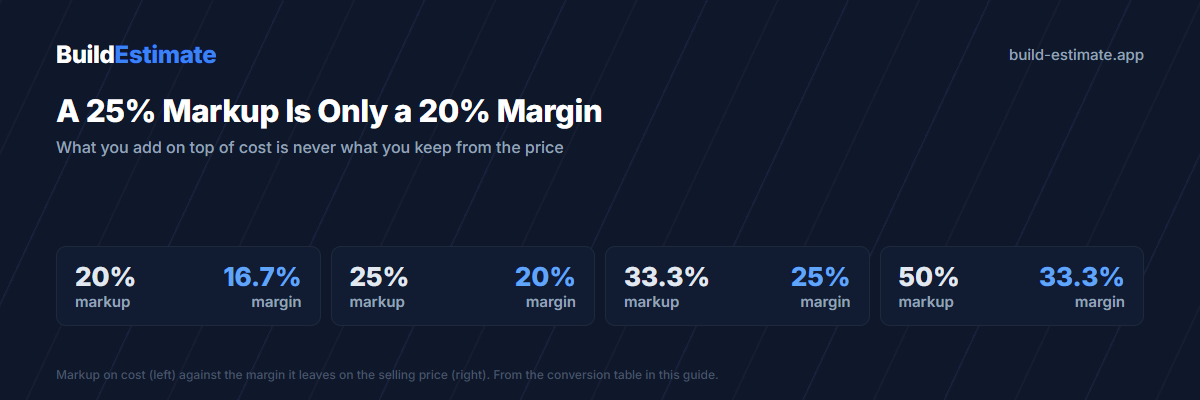
| 20% | 16.7% |
| 25% | 20% |
| 33.3% | 25% |
| 50% | 33.3% |
| 100% | 50% |
Read it the other way when you're pricing: if you want a 20% margin, add a 25% markup; for a 25% margin, add 33.3%; for a 33.3% margin, add 50%. The gap between the two columns widens as the numbers grow, which is exactly why the confusion gets more expensive the bigger the job.
A worked example: pricing a job the right way
Say a job's full cost comes to £1,000 — and that means everything the job carries, which we'll break down in the next section. You've decided you need a 20% margin to run the business properly. Price it straight from the margin formula:
£1,000 ÷ (1 − 0.20) = £1,000 ÷ 0.80 = £1,250
That £1,250 price contains £250 of profit, which is 20% of £1,250 — the margin you set, delivered exactly. The "add 20%" instinct would have produced a £1,200 quote and only a 16.7% margin, so the correct method protects £50 on every £1,000 of cost. Scale that up: on a £10,000 job the same slip is £500 of profit handed over for nothing, and across a year of jobs it is real money you never see.
Cover every cost first, then apply the margin
A margin only protects your profit if it sits on top of a complete cost. The number one reason a "20% margin" turns into far less is that the 20% was added to a total that quietly left costs out. Before you apply any margin, make sure the cost you're pricing from includes all of the following:
- Materials — everything on the job, plus the waste, offcuts and small consumables that never make it onto a takeoff but always get used.
- Labour — every hour on the job at your real rate, including the second pair of hands and the fiddly finishing time that always runs longer than planned.
- Plant and hire — access equipment, tools hired in, skips and welfare. Hire that's forgotten at quote stage comes straight out of profit later.
- Overheads and prelims — your share of van, insurance, software, admin and the site set-up costs (deliveries, site tidy, protection) that belong to the job even though no single line pays for them.
Add all of that up first — that total is your true cost. Then, and only then, apply your margin on top of the full figure. Apply it to materials and labour alone and forget the overheads, and those overheads eat straight into the profit you believed you'd priced in. Building the cost up line by line is the whole point of a proper estimate; our guide to how to estimate a construction job walks through the takeoff and cost build-up that this margin sits on top of.
Why margin — not markup — protects your profit
Markup is the easier number to reach for: it's one sum on a calculator, cost times a percentage, done. But easy isn't the same as safe. Because a markup is measured against cost, it flatters itself — a markup that sounds generous can hide a margin that's thin. Margin is measured against the price the customer actually pays, so it tells you the truth directly: what share of the job you keep.
That's why the professional habit is to set the margin you need and work the price up to reach it, rather than add a markup and hope it lands somewhere healthy. Your margin is the number the business actually lives on — it covers the lean months, the bad debt, the job that overruns and the growth you want — so it deserves to be chosen on purpose, not left as whatever falls out of a markup.
Keep your margins consistent across every quote
Pricing every job to the same target margin is what turns individual quotes into a business you can plan. When every quote carries the same intended margin, your profit becomes predictable: a busy month means a proportionally profitable month, not just a tired one. When margins wander job to job — a bit off here to win the work, a round-number markup there at the kitchen table — profit becomes a lottery you can't forecast.
Consistency also makes it obvious when a job shouldn't be priced to the standard margin — tricky access, an awkward client, a lot of risk — because you're deciding to move off your baseline deliberately, not drifting off it by accident. Once the price is set, the quote itself has to hold that margin in place with a clear scope and exclusions, which is exactly what our guide to how to write a construction quote covers. And if you price labour by the day, make sure the day rate underneath all this is built on real numbers too — see how to set your day rate.
Common margin and markup mistakes
- Treating a markup as a margin — adding 20% and believing you kept 20%, when you kept 16.7%.
- Applying margin to an incomplete cost — forgetting overheads, prelims, hire or waste, so the real margin is thinner than the one you set.
- Using markup because it's the easy sum — reaching for cost × percentage without checking what margin it leaves you.
- Letting margins wander between quotes — a different number on every job, so profit can't be predicted or planned.
- Never revisiting the target — material and labour costs move; a margin set two years ago may no longer cover what the business needs.
- Discounting off the price without re-checking the margin — "knocking off 10%" can wipe out most of a thin margin in one line.
How BuildEstimate keeps your margin under control
Getting the maths right in your head is one thing; holding it consistently across every quote, at speed, is another. BuildEstimate is a UK-focused, AI-assisted quoting app that builds itemised estimates with materials and labour, lets you apply your markup or margin to the full cost, and turns the result into a professional quote — from your phone or your desktop. Because the price is built up from itemised costs rather than a number rounded in your head under pressure, the margin you intend is the margin the quote carries, job after job.
You can use it as a web app at build-estimate.app, and it is also available on the App Store and Google Play.
Prefer to see the numbers first? View pricing — it is £20/month with a 7-day free trial.
FAQ
What is the difference between margin and markup?
Markup is your profit expressed as a percentage of cost: selling price = cost × (1 + markup). Margin is the same profit expressed as a percentage of the selling price: selling price = cost ÷ (1 − margin). They measure the same pounds of profit against two different bases, so the two percentages are never equal — the margin is always the smaller number.
Is a 20% markup the same as a 20% margin?
No. A 20% markup on £1,000 of cost gives a £1,200 price and £200 profit, but £200 of a £1,200 price is only a 16.7% margin, not 20%. To actually keep a 20% margin you need a 25% markup, which gives a £1,250 price. Treating a markup figure as if it were the margin is the single most common — and most expensive — pricing mistake in the trades.
How do I convert markup to margin and back?
To turn a markup into a margin, divide the markup by one plus the markup: margin = markup ÷ (1 + markup). To go the other way, divide the margin by one minus the margin: markup = margin ÷ (1 − margin). For example, a 25% markup is a 20% margin, and a 50% markup is a 33.3% margin.
Should I price a job on margin or markup?
Price on margin. Margin is measured against the price the customer actually pays, so it tells you directly what share of the job you keep — which is what protects your profit. Markup is easy to add on a calculator, but a markup that sounds healthy can hide a margin that is much thinner. Set the margin you need, then work the price up to reach it.
Do I apply margin before or after adding overheads?
After. Cover every cost the job carries first — materials, labour, plant and hire, and a fair share of your overheads and prelims — then apply your margin on top of that full total. If you add margin only to materials and labour and forget overheads, the overheads eat straight into the profit you thought you had priced in.
Why do my quotes keep coming out less profitable than expected?
Usually because a markup was mistaken for a margin, or because some costs — overheads, prelims, waste, small consumables — were left out of the total the margin was applied to. Both make the real margin smaller than the number in your head. Building the price from a full, itemised cost and applying a consistent target margin removes the guesswork.