Provisional Sums and PC Sums: How to Quote Them Without Losing Money
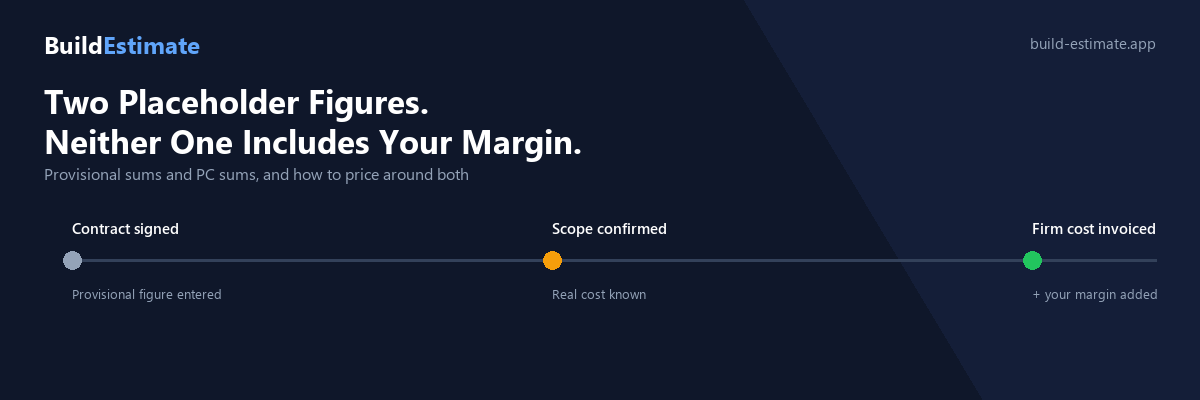
Two line items sit in nearly every JCT contract that nobody explains properly before you sign: the provisional sum and the PC sum. Get the difference wrong, price either one flat with no margin attached, and the shortfall comes straight out of your pocket once the real figure lands.
This guide covers what each one actually is, where the money quietly leaks if you price them wrong, and how to convert them to firm costs without an argument at the end of the job. It sits alongside our guides on pricing variations and margin vs markup — worth reading if you haven't, since the maths here builds on both.
What a provisional sum actually is
A provisional sum is money set aside in the contract for work that's definitely going to happen but can't be priced accurately yet. Groundworks are the classic case. Nobody knows exactly what's under a Victorian terrace's back garden until someone digs it up, so the contract carries a provisional sum, say £3,000, as a placeholder for whatever turns up. Once the trench is open and the actual scope is clear, that figure gets replaced with a real one.
NRM2, the rulebook JCT contracts lean on for how these things get measured, splits provisional sums into two types. A defined provisional sum means enough is known about the work, its nature, how it's carried out, roughly where and how much, that you're expected to have allowed for it in your programme and preliminaries already. An undefined one means almost nothing is known, so you haven't priced any knock-on time or disruption into your rates at all. Mixing the two up is where a lot of contractors lose weeks of programme they never got paid for.
What a PC sum is
A prime cost sum, PC sum for short, is different. It's an allowance for the cost of goods or work that a nominated supplier or subcontractor will provide, where the client hasn't picked the exact product or firm yet. Kitchen units are the textbook example. The contract might carry a £4,500 PC sum for the kitchen supply, because everyone knows kitchen units are going in, but the client hasn't chosen the range or the retailer.
The PC sum itself only covers the cost of the item or the nominated firm's work. It doesn't cover your profit, your overheads, or the time your labour spends unloading and fixing whatever eventually turns up. That's the bit people forget, and it's the exact bit that erodes a margin quietly over the life of a job.
| Provisional sum | PC sum | |
|---|---|---|
| What it covers | Work not yet fully defined or designed | Cost of goods or works from a supplier not yet chosen |
| Typical example | Groundworks, drainage, opening-up | Kitchen units, sanitaryware, ironmongery |
| Final figure set by | You, once the scope is known | Usually the client, once they've chosen |
| Your risk if unpriced | Absorbing extra time and disruption | Absorbing your own profit and attendance |
Where the money actually leaks
Here's the part that catches people out three or four jobs in, not on the first one. A provisional sum of £3,000 for groundworks isn't £3,000 of profit sitting there waiting for you. It's £3,000 of budget for materials, plant hire and labour on work you haven't costed yet, because you can't. If you quote the job assuming that £3,000 already includes your normal margin, and it turns out the real groundworks bill is £3,400 once you've dug the hole, you're not just short £400. You've done the extra work at zero profit on top of it.
PC sums leak differently. Say the contract carries £4,500 for kitchen units and the client eventually spends £6,200 with the supplier they liked. Good news on paper, more scope, more value in the job. Except if your quote never built in a profit and attendance percentage on top of the PC figure, that extra £1,700 passing through your books earns you nothing beyond the hassle of a fitter standing around while units get checked off against a packing list.
Pricing around provisional sums without eating the risk
- State the figure as an allowance, not a fixed price, on the quote itself. Write "provisional sum, subject to confirmation once site conditions are established" next to it, not just the number on its own.
- Build your preliminaries around whether it's defined or undefined. If it's a defined provisional sum under NRM2, you're expected to have allowed programme time for it already, so make sure you actually have, in writing, before you agree the contract.
- Agree the mechanism for converting it to a firm cost before you start. That means agreeing now whether the final figure gets priced by day rate, by a schedule of rates already in the contract, or by a fresh quotation once the scope is known, not arguing about it mid-job when the client's already banked the discount and you've got nothing left to negotiate with.
- Add your margin to the whole job, not just the defined scope. If groundworks come in over the provisional figure, the client pays the difference, but your rate for doing that extra work should carry the same profit percentage as everything else you've quoted, not a bare-cost rate you agreed to under pressure.
Pricing around PC sums without eating the risk
This one's simpler once you know the trick: always add a profit and attendance percentage on top of the PC sum, stated separately on the quote. Ten to fifteen percent is common on smaller domestic jobs, sometimes less on larger commercial ones where the PC value itself is bigger. Call it out as its own line: "PC sum £4,500, plus 12% for profit and attendance." That way nobody's surprised later, and you're not trying to claw margin back out of a number the client already thinks is final.
If the client ends up choosing a more expensive product than the PC sum allowed for, and most do, the percentage you quoted still applies to the new figure. Higher spend, proportionally higher margin for you, exactly as it should be. If they choose something cheaper, you're covered too, because the percentage moves with the actual figure rather than being fixed to the original estimate.
Converting to firm costs once the real number lands
Once the groundworks are dug, or the kitchen supplier's invoice arrives, the provisional or PC figure gets replaced with the actual one. This should be a formal step, not something that happens by accident when someone notices the final invoice doesn't match the contract sum.
- Write it down as a variation or contract instruction the moment the real figure is known, referencing the original provisional or PC sum it replaces.
- Show the client the maths: original allowance, actual cost, the difference, and your agreed percentage applied to that difference if it's a PC sum.
- Get sign-off before the next payment application goes in, not after. A contract sum that's drifted without a paper trail is the single most common reason retention and final accounts drag on for months after practical completion.
Where BuildEstimate fits in
BuildEstimate won't negotiate your attendance percentage for you, and it can't tell you what's under next door's garden. What it does is keep provisional sums and PC sums as their own labelled line items on the quote, with your margin applied automatically rather than buried inside a number the client thinks is fixed. When the real figure comes in, you update that one line, not the whole document, and the audit trail of what changed and when is already there.
Prefer to see the numbers first? View pricing — it is £20/month with a 7-day free trial. Our guides on pricing variations and margin vs markup cover the related ground this one doesn't.
FAQ
What's the difference between a provisional sum and a PC sum?
A provisional sum covers work whose scope isn't fully known yet, like groundworks before the trench is open. A PC sum covers the cost of a product or subcontracted work where the item itself hasn't been chosen yet, like kitchen units before the client's picked a supplier. Both are placeholder figures in the contract sum, replaced with real numbers once the details are confirmed.
Do I earn profit on a provisional sum?
Only if you've quoted it that way. The provisional sum itself is a budget for materials, plant and labour on undefined work, not a profit pot. Your margin needs to be added to whatever the actual cost turns out to be, using the same rate you've applied to the rest of the job, agreed with the client before work starts.
How much should I add on top of a PC sum for profit and attendance?
Ten to fifteen percent is typical on domestic and small commercial jobs, though it varies with the size of the PC value and how much coordination the item actually needs. State it as a separate line on the quote so the client sees it as a normal part of the cost, not something you're adding on afterwards.
What happens if the actual cost comes in under the provisional sum?
The client pays less than the contract sum originally allowed for, and that's a legitimate reduction, not something to argue about. It cuts both ways: if you've quoted the profit percentage correctly, a lower actual cost simply means a smaller variation in the client's favour, and a slightly smaller margin figure for you on that one line.
Can a provisional sum or PC sum be removed from the contract entirely?
Yes, if the work or item turns out not to be needed at all, or gets covered elsewhere in the contract. It should still be dealt with formally, as an instruction confirming the omission, so the contract sum and your final account both reflect it properly rather than the figure just quietly disappearing.
Is a PC sum the same as a provisional sum under NRM2?
No, and NRM2 treats them differently on purpose. Provisional sums split into defined and undefined categories depending on how much is known about the work. PC sums are specifically for cost allowances tied to nominated suppliers or subcontractors. Confusing the two in a quote is one of the more common reasons contractors under-price the programme risk that comes with defined provisional sums.
Who decides what the kitchen or sanitaryware item actually is?
Usually the client, sometimes with input from a designer or architect if one's involved. Your job is to price the coordination and fitting, plus your profit and attendance percentage, not the product choice itself. Flag a sensible deadline for the client to choose, because a PC sum item picked three weeks late can hold up everything scheduled after it.
Does VAT work differently on provisional sums or PC sums?
No. VAT and the domestic reverse charge, where it applies, follow the same rules as the rest of the invoice once the provisional or PC figure is converted to a firm cost. There's no separate VAT treatment for these line items specifically, so treat the final figure the same way you'd treat any other part of the job. See our guide on the VAT reverse charge for how that invoicing works.
Both provisional sums and PC sums exist so a contract can be signed before every last detail is settled. That's fine, and it's normal. What isn't fine is treating either figure as a fixed number that already includes your margin, because neither one does. Price the allowance, price your percentage separately, and write the conversion down properly when the real number finally lands.