Completion Certificates: What They Do to Your Final Payment
You finish the rewire, the client's delighted, and you send the final invoice the same week. Three months later it's still unpaid, because their solicitor is remortgaging the house and wants the building regulations completion certificate first, and nobody applied for one. That's not a hypothetical. It's the single most common way a finished, well-done job turns into an unpaid one, and none of the guides already on this site cover it.
A completion certificate has nothing to do with whether the work is any good. It's proof that building control signed it off, and it can take weeks to arrive after the last screw goes in. If your final payment milestone is worded around "certificate received" rather than "practical completion", you've handed a third party's paperwork timeline the power to hold your money hostage.
What a completion certificate actually proves
A completion certificate (or a final certificate, if an Approved Inspector did the job instead of the local authority) is confirmation that building control inspected the finished work and is satisfied it complies with the Building Regulations. It's not a quality mark. It's not a warranty. A job can be certified compliant and still have a wonky architrave or a tap that drips. Conversely, a job with genuinely excellent workmanship can sit uncertified for months because nobody submitted the paperwork on time.
Most homeowners don't know the difference between planning permission and building regulations approval, and plenty conflate both with "is my extension legal." You'll save yourself a conversation later if you explain, at quoting stage, which one applies to their job and who's applying for it.
The five-day rule most builders never hear about
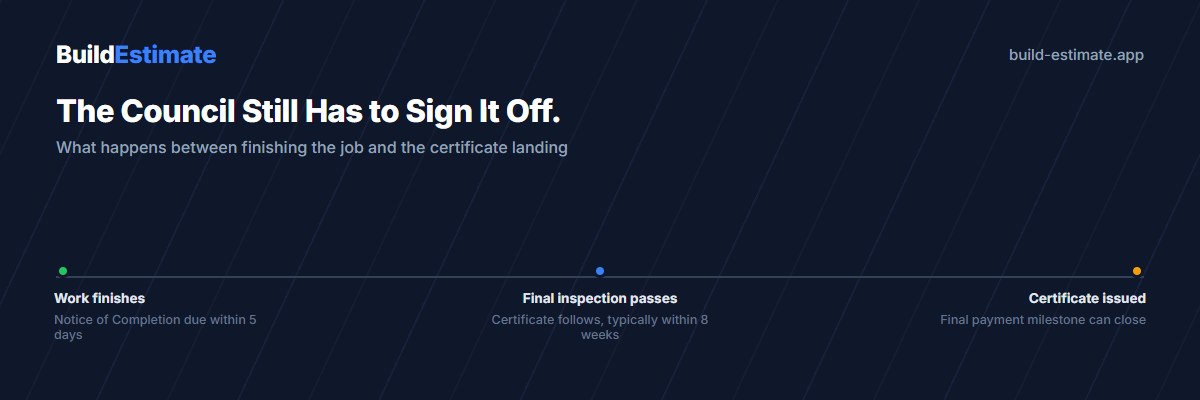
Once the work is finished, someone has to tell building control. Regulation 17 requires a Notice of Completion within five days of the work being done. Miss that window and the local authority is under no obligation to issue a certificate at all, no matter how good the job is. On a lot of domestic jobs this notice is the builder's job, not the client's, and it's easy to let it slide once the final coat's dry and you're already on the next site.
How long it actually takes
There's no single national answer, because it depends on the council. Once building control is satisfied every required inspection has passed, a completion certificate typically follows within eight weeks, and there's no charge for the first copy since the fee was folded into the application charge back in 2013. Some councils are quicker. A handful process paperwork within days of the final inspection passing; others genuinely use most of the eight weeks, especially over Christmas or during a staff shortage. Ask the client's local authority directly if the timeline matters to the payment schedule. It usually does.
Local authority or Approved Inspector: different name, same job
Building control on a job is either the local council or a private Approved Inspector, and both routes end the same way: a document confirming compliance. The council calls it a completion certificate. An Approved Inspector calls it a final certificate. Functionally they're interchangeable, and a lender or conveyancer treats either one as satisfactory proof. The one thing only the council can do is issue a regularisation certificate for work that was never signed off at all, which matters if a job started under one arrangement and the paperwork got lost somewhere in the middle.
Why a client can make this your problem
Here's where it lands on your invoice. If a client is selling or remortgaging, their solicitor will ask for the completion certificate as a matter of routine, and if it's not there yet, that solicitor will often hold up the transaction rather than push it through. A client mid-sale, waiting on paperwork you're technically responsible for triggering, is a client with a very good reason to sit on your final payment. They're not necessarily being difficult. Their buyer's lender genuinely won't release funds without it, or without an indemnity policy standing in for it.
This is also where a badly worded payment schedule bites hardest. "Final payment on completion of works" is fine when everyone agrees what "completion" means. "Final payment on receipt of completion certificate" quietly outsources your cash flow to your local council's post room.
When nobody applied for one
If work went ahead years ago without building control ever being told, and it now needs signing off, that's a regularisation certificate, not a standard completion certificate, and only the local authority can issue it. It costs more. Fee structures vary by council, but a typical approach charges 150% of what the equivalent Building Notice would have cost, with no VAT added on top. Warwick District Council's published schedule, as one real example, prices an unauthorised loft conversion under 60 square metres at £690 plus a 50% premium, which comes to £1,035. It only applies to work carried out after 11 November 1985, and the fee isn't refundable even if the surveyor finds a problem that needs fixing before they'll sign it off.
If you're quoting to finish or fix a previous builder's uncertified work, ask early whether that work was ever notified to building control. It changes both the price and the paperwork trail, and it's a far better conversation to have before you start than after the client's solicitor rings you asking why there's no record of the job.
Indemnity insurance: the fallback, not the fix
When a certificate genuinely isn't coming, whether because the work predates 1985, the council's gone quiet, or getting one retrospectively isn't worth the disruption, indemnity insurance is the usual workaround. It's a one-off policy, typically a few hundred pounds, that protects against the local authority taking enforcement action over the missing paperwork. Sellers usually pay for it to get a sale moving. What it doesn't do is cover the cost of putting right any work that turns out not to comply. It's a paperwork fix, not a workmanship guarantee, and it's worth knowing the difference before you recommend it to a client as a way out.
Building it into the quote
None of this changes how you price the job itself. It changes what you promise about when the money lands.
- Tie the final payment milestone to practical completion and client sign-off, not to a certificate arriving from a third party you don't control.
- Submit the Notice of Completion within five days and keep proof you did — a screenshot of the portal confirmation is enough.
- Tell the client upfront, in the quote, roughly how long building control usually takes locally, so it's not a surprise if they're planning to sell soon after the work finishes.
BuildEstimate won't chase a completion certificate for you. What it will do is let you set out a payment schedule against clear, dated milestones when you send the quote, so the final instalment is tied to work you actually control finishing, not to a council's post room. See our guides on getting paid on time and retentions for the rest of a job's payment structure.
Prefer to see the numbers first? View pricing: it is £20 per month or £220 a year, with a 7-day free trial and no card required to start.
FAQ
Can a client legally refuse final payment until the certificate arrives?
Not unless your contract says so. If the payment schedule is tied to practical completion, the certificate is irrelevant to what they owe you, and a client withholding payment on those grounds is simply in breach. The trouble is most domestic contracts are vague enough that either reading is arguable, which is exactly why it's worth naming practical completion explicitly rather than leaving the milestone open to interpretation after the fact.
How long should I tell a client to expect the certificate to take?
Up to eight weeks from a satisfactory final inspection is a safe general answer, though plenty of councils are faster once every inspection has passed. If the client's sale or remortgage timing depends on it, tell them to ring their local authority's building control team directly rather than relying on a guide like this one for their specific council's current turnaround.
What if the council never issues one at all, even after every inspection passed?
Chase it in writing, and keep the record. In the rare case where a council genuinely won't issue a certificate despite compliant work and a timely Notice of Completion, the client's solicitor will usually accept written confirmation from building control that the file is complete and outstanding only on their end, or fall back on indemnity insurance for the interim.
Does an Approved Inspector's final certificate carry the same weight as a council one?
Yes. Lenders, conveyancers and future buyers treat a final certificate from an Approved Inspector exactly the same as a local authority completion certificate. The only thing an Approved Inspector can't do is retrospectively regularise work that was never notified to anyone at the time; that's a council-only power.
What happens if I didn't submit the Notice of Completion within five days?
The council isn't obliged to issue a certificate at all once that window's passed, but in practice most will still inspect and certify a late notification, especially if the delay was short and the work's compliant. What you lose is certainty. Submit it on time and it's a formality; miss it and you're relying on the council's goodwill rather than their obligation.
Can I do the work first and regularise it afterwards to save time?
You can, but it usually costs more than doing it properly the first time, and it only works for work carried out after 11 November 1985. A regularisation surveyor may also ask to open up finished work to check it, which nobody wants to do to a plastered wall six months after the event. It's a genuine fallback for uncertified historic work, not a shortcut for a job you're about to start.
Does any of this apply to a straightforward rewire, or only structural work?
It applies to anything notifiable under the Building Regulations, which includes most electrical work covered by Part P, not just structural extensions and loft conversions. A rewire, a new consumer unit, or work in a kitchen or bathroom can all need building control sign-off depending on scope, and the same five-day notice and certificate process applies regardless of whether the job involved a single trade or a full extension.
Is this the same thing as planning permission?
No, and mixing the two up is the single most common client confusion on this. Planning permission is about whether you're allowed to build something at all: size, position, use. Building regulations approval is about whether what gets built is structurally sound and safe, regardless of whether planning permission was needed in the first place. A job can need one, both, or neither, and a completion certificate only ever relates to the building regulations side.
None of this means building regs paperwork should hold up a job that's actually finished. Most certificates arrive without drama, and most clients aren't trying to dodge a bill. It's a reason to say, in writing, what "final payment" is actually tied to, before the last invoice goes out rather than after someone's solicitor gets involved.