Snagging: How to Price the Last 5% of a Job
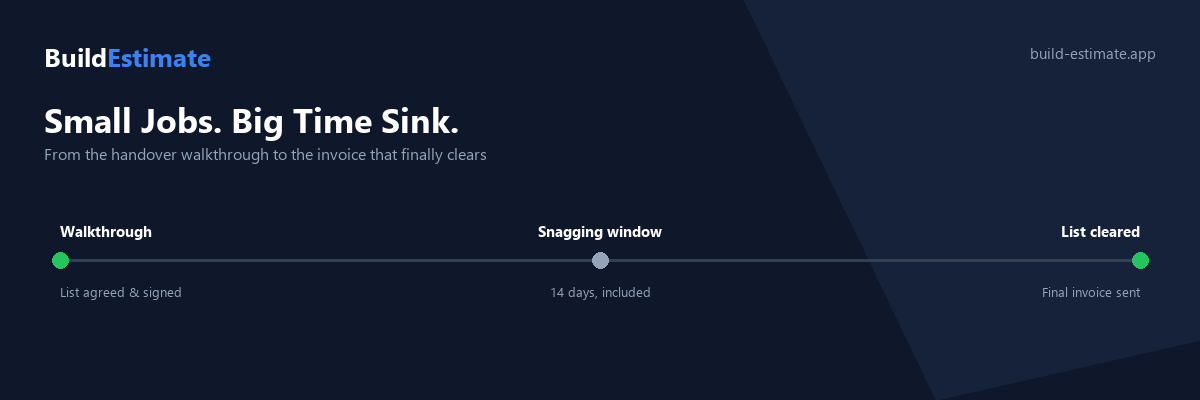
The job's basically done. Units are in, the client's already told her sister to come round and see the kitchen. Then the walkthrough happens and out comes the list: a door that doesn't close square, a scuffed skirting board, a socket a centimetre off level, three patches of paint that need a second coat. None of it takes long on its own. All of it together can eat two days you never quoted for.
That's snagging. Most trades either eat the cost of it quietly, or never actually work out what it's costing them, job after job, until the numbers stop adding up at year end. This guide covers what actually counts as snagging, why it costs more than its share of the job, and how to price it so the last 5% stops being the bit that quietly loses you money. It's a companion piece to our guides on retentions and pricing variations — worth reading either if the terms overlap for you.
What counts as snagging
Snagging is the list of small, usually cosmetic or functional defects spotted once a job looks finished but isn't quite there. A door that binds on the frame. A tap that weeps slightly at the base. Paint that dried patchy where the light catches it. It's not a variation, because the client didn't ask for anything extra or different. And it isn't the same as a defect that turns up months later under a warranty or a defects liability period, which is a separate conversation covered in our guide on retentions.
Some contracts draw a hard line between snagging and defects based on timing alone. Snagging is what's found before sign-off, on the handover walkthrough. Defects are what's found after, once the client's living in the space and something fails that shouldn't have. On a lot of smaller domestic jobs nobody's that precise about the label. It's all just the list of stuff to sort before the final payment clears.
Why the last 5% costs more than 5% of the job
If snagging genuinely represented 5% of the job, it would take roughly 5% of the time the rest of it took. It almost never does, and there's a reason for that, not just bad luck.
A day spent snagging a kitchen fit is rarely one continuous day. It's forty minutes here, an hour there, spread across a week because the client's only free after six and the tiler hasn't finished the splashback yet. Your tools are already packed. The van's loaded for the next job. Every return visit costs you a drive, a parking space, twenty minutes of setup for a task that might take ten. Multiply that by six or seven small items scattered over three visits and the maths that looked like half a day on paper turns into a day and a half in reality.
There's also the ordering problem. Snagging often depends on someone else finishing first. You can't touch the paint until the plumber's stopped dripping under the sink. You can't adjust the door until the flooring's down and the client's decided the gap looks wrong. Waiting for other trades to clear their own list before you can start yours is dead time nobody bills for, because nobody quoted for it.
The three ways trades end up pricing it for free
The first is treating practical completion as the finish line and everything after as goodwill. You hand the keys back, the invoice goes out for the full job, and anything the client spots on the walkthrough gets fixed on a Saturday morning because you feel you should.
The second is assuming the tail end will be quick simply because the bulk of the job was. A kitchen fit that ran smoothly for three weeks tells you nothing about how long the last five items will take, because those five items are, almost by definition, the ones that got left until last for a reason.
The third is letting the walkthrough turn into an open list with no cut-off. The client spots one thing, then remembers another while you're fixing the first, then notices a third once the first two are done. Without an agreed date the list can grow for weeks, and every extra item is more unpaid time.
How to actually price for it
Build a stated snagging allowance into the quote itself, not a vague promise buried in conversation. Something like "up to four hours of reasonable snagging within 14 days of completion, included in the price" tells the client exactly what's covered and gives you a hard boundary. Beyond that, your normal hourly or day rate applies, and you've already told them that in writing.
This isn't a figure anyone publishes officially, and it varies a lot by trade and job size, but plenty of experienced estimators build something in the region of one to three per cent of the job's value into their pricing to cover finishing and snagging time, rather than absorbing it silently. Whatever number you land on, name it on the quote. A number the client's seen and agreed to is a number you can actually charge if it's exceeded. A number that only exists in your head isn't.
| Snagging window | After the window | |
|---|---|---|
| What's covered | Reasonable items missed at handover | New items, or anything the client adds later |
| Typical timeframe | 14 days from practical completion | No fixed limit — that's the risk |
| Who pays | Included in the original quote | Chargeable as additional work |
Snagging versus retention
They get confused because they usually show up in the same conversation, but they're not the same thing. Retention is money: a slice of the contract value the client or main contractor holds back, typically around 5%, as security. Snagging is work: the physical list of items that need fixing before the job's considered properly finished. Our guide on retentions in construction covers how that holdback actually functions and how to price around it.
Where the two collide is that on a lot of contracts, the first tranche of retention doesn't release until practical completion is confirmed, and practical completion often isn't confirmed until the snagging list is cleared. A slow snag list doesn't just cost you the time to fix it. It can also delay money you're already owed for work you finished weeks ago.
Writing a snagging list that protects you
- Walk the job with the client together, once. Don't let it turn into photos sent over WhatsApp across three separate messages a week apart. Write the list down there and then, with both of you looking at the same document, and photograph each item as you note it.
- Agree a date for the fix, not a vague "soon." Put it in writing, even if it's just a text message confirming what was agreed on site.
- Treat the agreed list as the list. If something new turns up after you've fixed everything on it, that's either a genuinely missed item, which you fix, or a new observation, which is a fresh conversation about scope, the same as any variation.
When it turns into a dispute
Most snagging gets sorted without drama. Where it doesn't is usually when the client keeps adding to the list past the agreed date, or when payment gets tied to a list that never seems to reach zero. If that starts happening, the tools are the same ones that apply to any payment dispute: put the agreed scope and date in writing if you haven't already, invoice for what's genuinely complete, and don't let an unbounded snag list become an excuse to withhold payment on work that's actually finished. Our guide on getting paid on time covers the escalation steps if a client won't budge, and the guide on pricing variations is worth a read if you're not sure whether something belongs on the snag list or on a new invoice.
Where BuildEstimate fits in
BuildEstimate won't walk the job with you, and it won't stop a client adding one more item to the list on a Sunday evening. What it does is let you put a named snagging allowance on the quote itself, so it's there in writing from day one rather than something you have to explain after the fact. Track the agreed window against the job and the number on the final invoice already reflects what was included and what wasn't.
Prefer to see the numbers first? View pricing — it is £20 per month or £220 a year, with a 7-day free trial and no card required to start. If snagging is only part of what's eating your margin, our guides on pricing variations and getting paid on time cover the rest of it.
FAQ
What's the difference between snagging and a variation?
A variation is extra or different work the client has asked for, and it's chargeable on top of the original quote. Snagging is fixing something that should have been done properly the first time, spotted on the handover walkthrough, and it's typically covered by whatever allowance you built into your original price.
Is snagging free, or can I charge for it?
Reasonable snagging within an agreed window, and up to whatever allowance you stated on the quote, is normally treated as included. Anything beyond that window, or beyond the scope you agreed, is chargeable the same as any other work, provided you've told the client that in writing before you start.
How long should a snagging window be?
Fourteen days from practical completion is common on domestic jobs, though it varies with the size and complexity of the job. What matters more than the exact number is that there is one, agreed and written down, rather than an open-ended promise to sort anything that comes up.
Is snagging the same thing as retention?
No. Retention is money held back as security, usually a percentage of the contract value. Snagging is the physical work of fixing defects spotted at handover. They often interact, because retention release is frequently tied to the snagging list being cleared, but one is cash and the other is labour.
What happens if I don't fix the snagging list?
Depending on the contract, the client can withhold final payment or retention until it's done, and on larger jobs a persistently unresolved list can affect your relationship with a main contractor for future work. It's rarely worth leaving small items unfixed to save an hour, given what it can cost you in delayed payment or reputation.
Can a client keep adding to the snagging list indefinitely?
Not reasonably, and not if you've agreed a walkthrough date and a written list at the point of practical completion. Items spotted after that point, once the agreed list is cleared, are new observations rather than the original snag list, and it's fair to treat them as a separate conversation about scope and cost.
Should snagging time be quoted as a fixed allowance or an hourly rate?
Either can work, but a stated fixed allowance, like a set number of hours or a small percentage of job value, gives both sides a clear boundary. Once that's used up, falling back to your normal hourly or day rate for anything further is simple to explain and easy to invoice.
Does VAT apply differently to snagging work?
No. Snagging carried out as part of completing the original contract follows the same VAT treatment as the rest of the job, including the domestic reverse charge where that applies. It isn't treated as a separate supply just because it happens after the main fix-out. See our guide on the VAT reverse charge for how that invoicing works.
Price the last 5% properly and it stops being the bit of the job that quietly costs you money. Leave it unpriced, and it'll keep doing exactly that, one job at a time, until you notice the pattern.