Party Wall Notices: What They Do to Your Price and Programme
A loft conversion on a mid-terrace goes to quote in July. The drawing's fine, the steels are priced, the client's happy. Nobody mentions the neighbour until week two, when a solicitor's letter turns up and the start date written in the client's diary quietly slides by six weeks. You didn't cause that. You also didn't say it could happen.
The Party Wall etc. Act 1996 covers party walls, party structures, boundary walls and excavation near a neighbouring building. It applies in England and Wales only. Scotland and Northern Ireland rely on common law instead, so if you're pricing a boundary job north of the border, none of the notice periods below apply to it. Where it does apply, it gives a neighbour a legal right to know before certain work starts close to their property, and it gives the person doing the work a lawful route through if the neighbour objects.
This isn't a job you need to run. Serving the notice is the client's responsibility, not yours. But the delay lands on your programme whether you served the notice or not, and a good number of quotes go out without anyone having worked out whether it applies.
Three notices, three different clocks
The Act sets out three separate notices, each triggered by a different kind of work, each with its own minimum warning period before anything can start. Get the wrong one, or miss that one applies at all, and the whole programme moves.
| Notice | Triggered by | Minimum notice period |
|---|---|---|
| Line of junction (section 1) | Building a new wall astride or up to the boundary line | 1 month |
| Party structure (section 2) | Work to an existing party wall — cutting in, underpinning, raising, rebuilding, inserting steels | 2 months |
| Adjacent excavation (section 6) | Digging within 3m of a neighbouring building (or 6m if the dig cuts a 45° line from their foundations) | 1 month |
A loft conversion that needs steels bearing into the party wall sits squarely under section 2. A rear extension with new foundations close to the boundary is often a section 6 job, sometimes both at once. A garden wall built right on the line is section 1. It's common for one project to trigger more than one notice, and each one runs its own clock from the date it's served, not from when the job was agreed.
The 14 days that decide the timeline
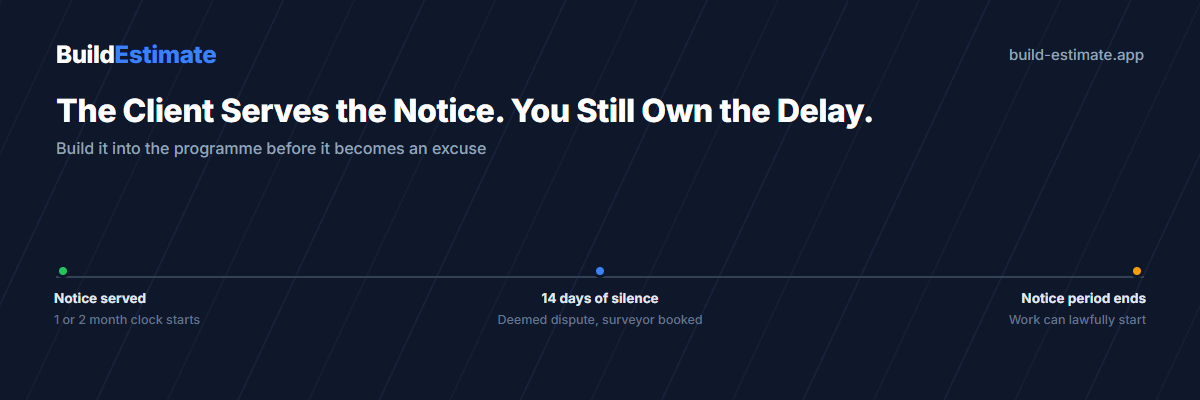
Once a notice is served, the neighbour, the adjoining owner in the Act's language, has 14 days to respond. They can consent in writing, dissent in writing, or say nothing.
For a section 2 or section 6 notice, silence is treated as dissent. A dispute is deemed to have arisen automatically, and the matter goes into the Act's surveyor process rather than sitting unresolved. That process usually means either one surveyor agreed by both sides, or each side appointing their own, with a third surveyor available to break a deadlock between them. The surveyors draw up an award: what work is permitted, what safeguards apply, and who pays what. Work affecting the party wall can't lawfully start until that award is served, and getting there realistically adds weeks on top of the original notice period, sometimes considerably more if either surveyor is slow or the neighbour is difficult.
For a section 1 line of junction notice, silence works differently. If the adjoining owner doesn't consent, the building owner has to build the new wall wholly on their own land and entirely at their own cost — no award needed, but also no shared wall and no shared cost, which changes the job itself.
None of this needs a dispute to actually be hostile. Plenty of neighbours consent within a week because they've got no objection and just haven't read the notice carefully. But "probably fine" isn't a programme, and a client who assumes a friendly wave over the fence counts as consent has assumed wrong.
What happens if nobody serves one
Skipping the notice doesn't make the Act go away. It just means the client is doing notifiable work without having followed the process that protects them if something goes wrong. A neighbour who finds out mid-job can apply for an injunction to stop work, which is exactly the kind of thing that turns a two-week delay into a much longer one, plus legal costs on top. If cracking or damage shows up later and there's no record of the wall's condition beforehand, arguing about who caused it becomes a lot harder for everyone, your client included.
It's also just avoidable. Serving notice correctly and early, with proper notice periods observed, is usually far cheaper than fixing a dispute that's already escalated.
Building the delay into the quote
None of this is your legal duty to sort out, but it changes what belongs on the job before you price it. Three things are worth doing at quote stage, not discovered in week two:
- Flag it early. If the drawing shows work on a shared wall or a dig close to the boundary, tell the client the Act is likely to apply before they've mentally committed to a start date.
- Put the notice period into the programme, not just the day rate. Two months for a party structure notice is two months your labour and materials booking has to sit behind, whatever the quote says about availability.
- Suggest a schedule of condition before work starts on or near the wall. It costs little next to the price of a dispute with no evidence either way, and it protects you as much as the client if a crack turns up that was there before you arrived.
The party wall clock isn't the only one that can hold up a start. On a building put up before 2000, licensable asbestos found in the survey means the removal contractor has to notify the enforcing authority at least 14 days before work begins. Our guide to the asbestos survey you need before you start shows what that fortnight does to a four-week programme.
BuildEstimate won't serve the notice for you or negotiate with the neighbour. It will let you write the notice period and the schedule-of-condition line into a quote as a proper item on the programme, with a validity date attached, rather than something everyone remembers only after the surveyor's letter lands. See our guides on estimating a job and CDM Regulations for domestic clients for the rest of pricing a compliant domestic job properly.
Prefer to see the numbers first? View pricing: it is £20 per month or £220 a year, with a 7-day free trial and no card required to start.
FAQ
Does the Party Wall Act apply to a normal house extension?
Often, yes. It applies whenever work touches a shared wall or structure, builds a new wall on or up to the boundary, or involves excavating within 3 metres of a neighbouring building (6 metres if the dig goes deep enough to cut a line taken down at 45 degrees from the underside of their foundations). A rear extension with new foundations close to the boundary is a classic trigger. A loft conversion that cuts into the party wall for steels is another. A single-storey job well inside the plot, nowhere near next door, often isn't.
Who has to serve the party wall notice, me or the client?
The client. The Act calls them the building owner, and the notice is their legal responsibility, not the contractor's. In practice most homeowners have never heard of it, so if you spot a job that's likely to trigger the Act, say so at quote stage rather than assuming someone else will. Some clients use a surveyor to draft and serve it for them; either way, it needs to happen before you're anywhere near a start date.
What happens if the neighbour doesn't reply within 14 days?
For a party structure notice or an excavation notice, silence counts as dissent. A dispute is deemed to have arisen, and the matter goes to the Act's surveyor process rather than stalling indefinitely. For a line of junction notice about a new wall astride the boundary, silence has a different effect: the building owner has to build the wall wholly on their own land and wholly at their own cost, without needing an award at all.
Can work start before the notice period ends?
Only with the adjoining owner's written consent to an earlier date. Without it, the statutory period has to run its course: one month for a line of junction or excavation notice, two months for a party structure notice. If a dispute is deemed and it goes to an award, work on the affected part can't start until that award is served, which routinely pushes the real start date well past the notice period alone.
Who pays the party wall surveyor's fees?
Usually the building owner, including the adjoining owner's surveyor's fees where the work is solely for the building owner's benefit, which most domestic extensions are. There's no set fee scale in the Act; section 10(13) leaves the cost of the award to the surveyors themselves, and it varies with whether one agreed surveyor handles both sides or each neighbour appoints their own. It's the client's cost, not something to fold into your quote, but worth flagging so it isn't a surprise.
Does the Act apply in Scotland or Northern Ireland?
No. The Party Wall etc. Act 1996 covers England and Wales only. Scotland and Northern Ireland don't have an equivalent statute, and boundary and party structure disputes there are handled under common law and, in Scotland, the law of the tenement instead. Don't quote a Scottish job assuming the same notice periods apply; they don't.
What's a schedule of condition and do we need one?
It's a photographic and written record of the state of the neighbouring property, usually the party wall and the rooms either side of it, taken before work starts. It isn't a legal requirement in every case, but it's standard practice on anything involving underpinning, cutting into a party wall, or excavation near a boundary, because it's the only clean way to settle an argument about whether a crack was already there. Cheap relative to the cost of a dispute with no evidence either way.
The Act doesn't care whether the job is a loft conversion or a full rebuild. What decides the timeline is which section applies, how the neighbour responds inside those 14 days, and whether anyone bothered to check before the quote went out. Ask the question at the drawing stage, not after the surveyor's letter arrives.