Retentions in Construction: What They Are and How to Price For Them
Finish the job, submit the final invoice, and 5% of it just doesn't turn up. Not disputed, not late in the normal sense. Held. That's a retention clause doing exactly what it was written to do, and if nobody walked you through it before you signed, the first time it registers is usually the moment your bank balance is a few hundred pounds lighter than you'd priced for.
This guide covers what a retention clause actually holds back, why main contractors use them, what they do to a small trade's cash flow, and how to price a job so the bit you don't get paid until next year doesn't put you in a hole this year. It's a companion piece to our guides on getting paid on time and the VAT reverse charge. We won't repeat either here, just flag where they overlap.
What a retention clause actually holds back
A retention clause lets the party paying you keep back a slice of every payment, usually as security against defects turning up after the work's done. Under the JCT suite of contracts, the default figure is 5% of the contract value, though anywhere from 3% to 10% shows up depending on who wrote the paperwork and how much weight they carried when they wrote it.
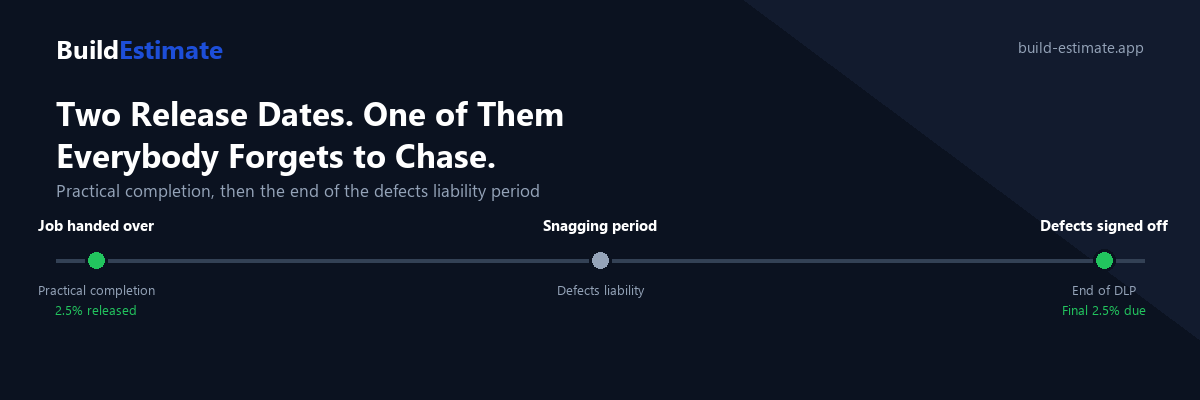
The 5% usually splits in half. Half comes back at practical completion, when the job's handed over and signed off as finished. The other half sits there until the end of the defects liability period, the window during which the contractor can call you back to fix anything that goes wrong. Twelve months is common for that period, though it varies by contract, and there's nothing stopping a client writing in 18 or 24 months if you don't push back.
Why contractors hold retention at all
From the paying side, it's straightforward insurance. If a subcontractor walks off site, goes under, or just doesn't come back to fix a leak they caused, the retention gives the contractor something to draw on without chasing anyone for money. It's cheaper than a bond and doesn't need underwriting. For a main contractor juggling dozens of subbies on one job, retention is the default risk tool, not a special measure aimed at any one trade.
That logic makes sense from where they're sitting. It doesn't make it free. Somebody's cash flow absorbs the cost of that insurance, and it's rarely the contractor's.
What it does to your cash flow
Here's the bit that doesn't show up until you've been trading a while. Retention isn't a one-off hit. If you're running several jobs a year, each with its own 5% held back and its own release date, you can end up with retention money scattered across half a dozen old contracts at any given time, most of it owed but none of it due yet.
Materials get paid for now. Wages get paid for now. Fuel, insurance, the tax bill, all now. The last chunk of what a job actually earned you can sit in someone else's account for the best part of two years if the defects period runs long and nobody chases the release date. That gap between money going out and the last piece of money coming in is exactly the kind of thing that sinks otherwise profitable small trades. Not because the job lost money. Because the job's profit arrived too late to pay this month's bills.
| At practical completion | At end of defects period | |
|---|---|---|
| Typical share released | 2.5% | 2.5% |
| Trigger | Job signed off as finished | Snagging fixed and signed off |
| Typical wait from job end | Immediate to a few weeks | Often 12 months |
| Who has to remember it | You, on the invoice | You, a year later |
Pricing so the hold-back doesn't sink you
The fix isn't to ignore retention and hope it works out. It's to price the job as if that final release might not show up on time, or at all.
- Quote on full value. Your rates, materials markup and labour cost should all be calculated against the full contract sum. Retention is a payment timing issue, not a discount you should be pricing into the job itself.
- Build a retention reserve into your cash flow planning, separate from your working capital. Treat the held-back 5% as money that exists but isn't available, and don't spend against it as if it's in the bank. Track each job's release date on a spreadsheet or in whatever job software you use.
- Price in the admin cost of chasing it. Chasing a £500 release a year after the job finished takes time, and time isn't free. If retention clauses are standard on the kind of work you do, factor a small amount into your rates to cover that admin rather than eating the cost silently every time.
- Don't let retention change your day rate math. If you calculate your day rate assuming every invoice gets paid in full and on time (worth checking against our guide on setting your day rate if you haven't run those numbers recently), a chunk of retention sitting unpaid for a year quietly wrecks that assumption. Build the delay into your cash flow forecast, not into a lower day rate.
Negotiating the terms before you sign
Most of what happens with retention gets decided the moment you sign the contract, not afterwards. A few things worth pushing on before that point:
- Capping the percentage. 5% is common but not universal, and plenty of contracts now run at 3%, particularly on public sector work where several government bodies have published lower retention policies. Ask for the lower figure before you sign, not after.
- Reducing the defects liability period. Twelve months is standard on most jobs. If a contract specifies 18 or 24 months, ask why, and ask whether it can come down. A longer defects period doesn't just mean more time for something to go wrong; it means your money sits out of reach for longer regardless of whether anything does.
- Bonding it out. On larger jobs, a retention bond from an insurer or bank lets you get paid in full up front, with the bond standing as security instead of cash held back. It costs a percentage fee to arrange, so it only makes sense once the retention value is big enough to justify the premium.
- Threshold clauses. Some contracts now specify no retention at all on smaller-value work, following years of campaigning from bodies like Build UK for retentions to be phased out on lower-value contracts. Worth asking the question even if the standard contract doesn't mention it.
None of this is guaranteed to work. Plenty of main contractors won't move on their standard terms for a subbie with no pull. But asking costs nothing, and a contract you never questioned is a contract you agreed to on someone else's terms by default.
When the release doesn't turn up on time
Retention that isn't released on the date the contract specifies is simply money you're owed and not being paid, and it's covered by the same rights as any other unpaid invoice under UK construction law. A few steps, roughly in order:
- Check the contract date first. Retention release dates are sometimes tied to a certificate (practical completion, making good defects) rather than a calendar date, so confirm the trigger event actually happened before assuming you're overdue.
- Invoice for it formally. Don't assume it'll get released automatically just because the date's passed. Send a proper invoice or application referencing the retention clause and the release date.
- Escalate in writing before you escalate by phone. A dated email or letter creates a record. If it goes to adjudication or court later, you'll want the paper trail showing you chased it and when.
- Know your statutory rights. Contracts caught by the Construction Act give you rights to interest on late payment and, in serious cases, the right to suspend further work for non-payment. Adjudication is available for retention disputes the same as any other payment dispute, and it's faster than court.
Where BuildEstimate fits in
BuildEstimate doesn't chase retention for you, and it isn't a substitute for reading your contract properly. What it does is make sure retention isn't a surprise buried three pages into a job. Build the estimate on the full contract value, note the retention terms on the quote itself, and the number you see when you invoice already accounts for what's held back and when it's due. Half the problem with retention isn't the money. It's forgetting the date it's owed.
Prefer to see the numbers first? View pricing — it is £20/month with a 7-day free trial. If retention isn't your only payment headache, our guides on getting paid on time and the VAT reverse charge cover the rest of it.
FAQ
What is a retention clause in a construction contract?
It's a term that lets the party paying you hold back a percentage of each payment, usually 5%, as security against defects. You get most of the invoice value now and the rest later, once the work's proved itself and any snags are fixed.
How much retention is normally held back?
Most contracts still specify 5% of the contract value, split into two chunks of 2.5% each, though figures from 3% up to 10% turn up depending on the contract and who wrote it. Public sector contracts are increasingly moving to lower percentages, so it's worth checking the actual figure rather than assuming 5%.
When does retention get released?
Usually in two stages. The first half comes back at practical completion, when the job is signed off as finished. The second half comes back at the end of the defects liability period, commonly twelve months later, once any snagging has been fixed and signed off.
Can I negotiate retention terms on a contract?
Yes, though it depends how much say you have before signing. It's worth asking for a lower percentage, a shorter defects period, or a retention bond instead of cash retention. None of it is guaranteed, but asking before you sign costs nothing and changes nothing if you don't.
What is a retention bond and is it worth it?
It's a guarantee from a bank or insurer that stands in for cash retention, letting you get paid in full while the bond covers the client's risk instead. It costs a fee to arrange, so it tends to make sense on larger contracts where the retention value justifies the premium, not on smaller domestic jobs.
What do I do if a retention isn't released on time?
Check the release trigger actually happened (practical completion or defects sign-off), then invoice for it formally and chase in writing. Retention that's overdue is an unpaid invoice like any other, and it's covered by the same statutory rights to interest and, if needed, adjudication under the Construction Act.
Does VAT or the reverse charge apply to retention payments?
Yes. Retention releases are still payments for the original supply, so the same VAT treatment applies as it did on the original invoice, including the domestic reverse charge if that applied when the work was billed. See our guide on the VAT reverse charge for how that invoicing works.
How do I price a job so retention doesn't wreck my cash flow?
Quote and cost the job on its full value, then treat the retained percentage as money that exists but isn't spendable yet. Track each job's release dates separately from your day-to-day cash flow, and build the admin time of chasing old retentions into your rates rather than absorbing it silently.
Get the check wrong and you find out about it a year later, when a job you thought was finished still owes you £500 and nobody can remember why. Write the retention terms down at quoting stage and you won't be the one who forgot.