Material Price Rises: How to Quote a Job Without Getting Burned
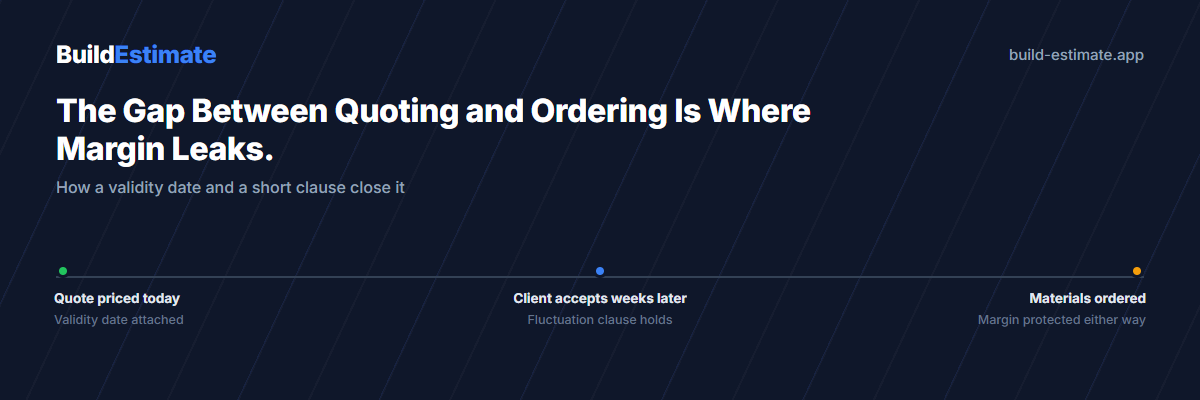
A roofer quotes a re-roof in April. The client takes six weeks to confirm, then wants to start in July. Between the quote and the first delivery, the price of the battens has gone up, the felt supplier has repriced twice, and the fixings are on back order at the old price plus 9%. Nobody did anything wrong. The market just moved while the paperwork sat in an inbox.
This happens on nearly every trade, not just roofing. Timber, steel, copper and aggregates all move on their own schedules, often for reasons that have nothing to do with the job in front of you. A quote with no wording about it means you either eat the difference or have an awkward conversation with a client who thinks the number they saw is the number they're paying. Neither is good. There's a third option, and it isn't complicated.
What's actually moving
The Office for National Statistics tracks a materials price index for construction, and the twelve months to June 2026 tell a mixed story depending on what you buy. The all-work index was up 6.0% year on year. That headline number hides some big swings underneath it: fabricated structural steel rose 17.7%, rigid pipes and fittings rose 12.0%, and gravel, sand, clays and aggregates rose 11.4%. Cement went the other way, down 4.5%, and ready-mixed concrete dropped 1.1%.
So it isn't a uniform "everything's up" story. A kitchen fitter buying mostly joinery and worktop is exposed to a different set of movements than a groundworker buying steel and aggregate, or a plumber whose pipework just got 12% more expensive in a year without anyone in the trade press making a fuss about it. Know which materials your job actually leans on before you decide how worried to be.
| Material category | 12-month change to June 2026 | Typical risk on a quote |
|---|---|---|
| Fabricated structural steel | +17.7% | High on anything with steelwork or long lead beams |
| Rigid pipes and fittings | +12.0% | High for plumbing, drainage and groundworks |
| Gravel, sand, clays and aggregates | +11.4% | High for groundworks, driveways and foundations |
| Ready-mixed concrete | -1.1% | Low, currently falling |
| Cement | -4.5% | Low, currently falling |
Price validity: pick a number, not a vibe
Most quotes drift into being open-ended by accident. Nobody writes "valid forever," but if there's no date on it, that's what it becomes, and a client who comes back in October holding a quote from March has a reasonable argument that you agreed to it. Fourteen to thirty days is standard for a job with volatile materials in it. Sixty to ninety days is fine for something mostly labour, or where the client needs time to sort finance or planning permission.
Put a date on it. "This quote is valid until 15 September 2026" does more work than any amount of small print, because it's a fact the client can check rather than a clause they have to interpret.
Writing a fluctuation clause that doesn't spook the client
Trade bodies have been pushing builders towards adding materials clauses since prices started swinging hard a few years back, and the wording that works is short. Something like: "Prices are based on material costs as of [date]. If supplier prices increase by more than 5% before materials are ordered, we'll notify you of the revised cost before proceeding." That's it. No essay, no legalese, just a threshold and a promise to tell them before it happens rather than after.
The 5% figure isn't fixed. Some firms use 3%, some use a flat cash amount on big-ticket items like a boiler or a full window set. What matters is that there's a number in there. "Subject to material availability" on its own means nothing to a client and won't hold up much better for you if it ever gets tested.
Split the job into what's fixed and what's exposed
Not every line on a quote carries the same risk. Labour, plant hire, and your own margin are yours to control and don't move because a mill in Turkey changed its steel pricing. Bulk materials bought close to the job, aggregates, ready-mix, some joinery, are usually fine to hold firm on a short job. The exposure sits with anything ordered weeks or months ahead, or anything where you're relying on a supplier's own quote that has its own expiry date.
Some firms split this on the page: a fixed labour and margin figure, and a materials allowance that's flagged as subject to the fluctuation clause. It reads as more professional, not less, because it shows the client you've actually thought about where the risk sits instead of hoping it doesn't move.
Lock it in with the supplier before you lock it in with the client
If a job has a long lead time, the cheapest protection isn't a clause at all. It's getting your own supplier to hold their price. Merchants will often confirm a price for 30 to 60 days on a decent-sized order, sometimes longer if you're a regular account and ask directly rather than assuming it's implied. That converts your risk into their risk, which is exactly where you want it, and it costs nothing but a phone call.
For anything genuinely large, boilers, kitchens, a full roof's worth of tiles, get the supplier confirmation in writing before you finalise the number to the client. A verbal "should be fine" from a rep isn't a locked price. It's an opinion.
When a price actually moves mid-job
Tell the client as soon as you know, not when the invoice goes out. A phone call plus a follow-up email with the new supplier price attached is enough. Most clients accept a genuine, evidenced increase far more easily than they accept a surprise on the final bill. What they won't accept is finding out after the work's done that the number changed weeks ago and nobody mentioned it.
Keep the supplier's price confirmation or invoice as your evidence. If the clause is worded properly and the increase clears your stated threshold, you're not asking for a favour. You're doing what the quote said would happen.
The mistakes that cost people money
Absorbing small increases quietly, on the theory that it's not worth the awkward conversation, is the most common one, and it adds up across a year of jobs faster than most tradespeople realise. A close second is vague wording that doesn't actually protect anything: "prices may be subject to change" gives you nothing to point to when a client pushes back, because it never said by how much or under what condition. And quoting a job with a six-week lead time using today's supplier price, with no clause and no supplier lock-in, is just hoping the market stands still for you. It sometimes does. Increasingly, it doesn't.
Where this fits on the quote
None of this is about charging more. It's about the number you write down surviving contact with a market that doesn't care about your timeline. BuildEstimate lets you attach a materials allowance and a validity date to a quote as standard fields, not something bolted on afterwards in the small print nobody reads. See our guides on estimating a job, margin vs markup and pricing variations for the rest of getting the number right before the fluctuation clause ever has to do any work.
Prefer to see the numbers first? View pricing: it is £20 per month or £220 a year, with a 7-day free trial and no card required to start.
FAQ
Can I legally increase the price on a quote a client has already accepted?
Only if the quote said you could. Once a client accepts a fixed-price quote, that's the contract, and you can't unilaterally add cost just because your supplier's prices went up. A written fluctuation clause, agreed before acceptance, is what gives you the right to pass on a genuine increase. Without one, you're stuck at the original figure even if it costs you money.
Is an "estimate" different from a "quote" for price rises?
Yes, and it matters here more than almost anywhere else. An estimate is a rough figure and generally isn't binding, so there's more room to revise it. A quote is a fixed offer the client can accept and hold you to. If a job has real material risk in it, that's a reason to quote with a validity date and a clause rather than leave it looser and hope nobody notices the difference.
What percentage increase is normal to build into a fluctuation clause?
No fixed rule. 3% to 5% is common as the trigger point. Go too low and you're pestering clients over price moves that barely register. Go too high and real increases get absorbed before the clause does anything. Match it to exposure: a job that's mostly steel and pipework can justify a lower trigger than one that's mostly labour and a bag of screws.
Do suppliers actually hold prices if I ask them to?
Often, yes, particularly on a decent-sized order and if you ask directly rather than assuming it's implied. Thirty days is common, sixty for a bigger account or a larger order. It's not guaranteed and it's not free insurance forever, but a phone call to confirm a hold price is one of the cheapest risk-management tools available and most tradespeople never ask.
What if the client refuses to accept a fluctuation clause?
Then you've learned something useful before you've committed to the job. You can offer a shorter validity window instead, which forces a decision sooner, or price the risk into the number upfront with a contingency built in rather than itemised separately. What you shouldn't do is drop the clause and hope the market cooperates, because on a long lead-time job with volatile materials, hope isn't a pricing strategy.
Does this apply to small jobs, or only bigger contracts?
It scales down fine. A same-week bathroom refit with materials bought within days barely needs it at all. A loft conversion quoted in spring for an autumn start, with steel beams and a full window set sitting in the middle of it, needs it a lot. Match the effort to the lead time and the materials involved. Not to how big the job feels on paper.
Where do I find current UK construction material price data?
The Office for National Statistics publishes a monthly materials price index covering both an all-work headline figure and individual material categories, free on gov.uk. It's worth a five-minute check before quoting anything with a long lead time or a material you know has been volatile, rather than relying on what a supplier told you six months ago.
Materials will keep moving whether you write anything down or not. A validity date and a short, specific clause don't stop that. They just mean the number you quoted is the number you're protected on, instead of a guess that quietly became a promise the day the client signed.