How to Price Variations and Extras on a Building Job
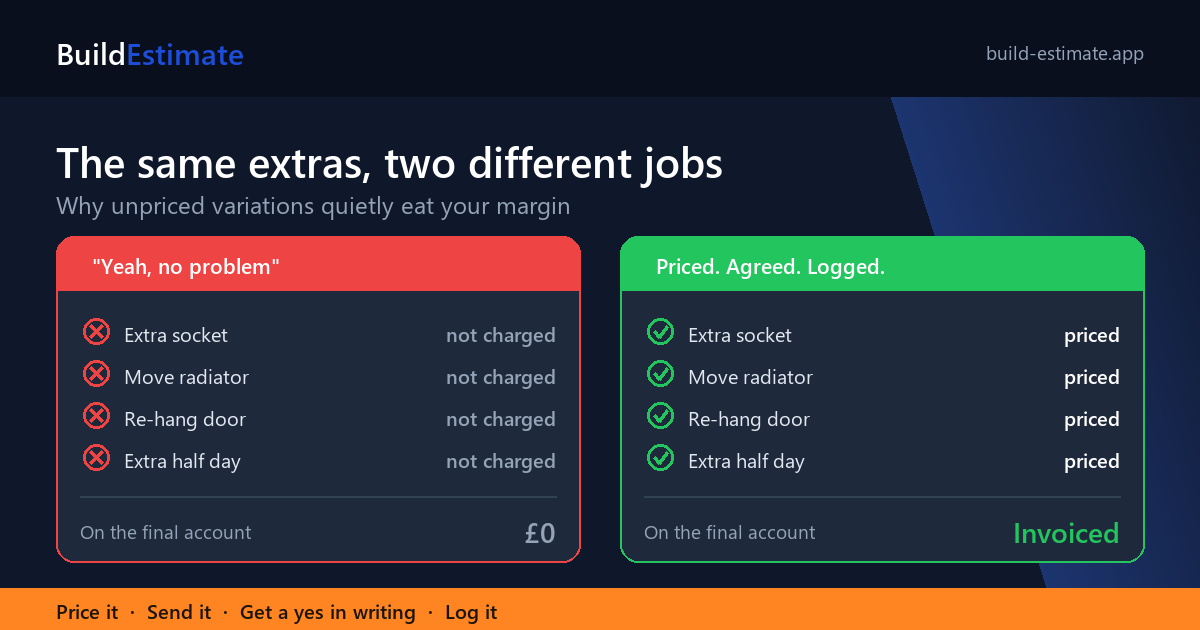
The quote was right. The job went well. The customer is happy. And somehow the money at the end doesn't match the money you priced. Nine times out of ten the gap isn't the estimate — it's everything that got added after it. A socket moved here, an extra course there, "while you're at it" repeated a dozen times over six weeks. Individually none of it feels worth stopping for. Together it is one of the biggest and quietest profit leaks in the UK trades. This guide covers what actually counts as a variation, how to price one properly, and how to get it agreed before you pick up a tool.
Why extras are the biggest silent profit leak in the trades
Underpricing a quote at least announces itself. You know the number was tight when you sent it, and you can learn from it next time. Extras don't work that way. They arrive one at a time, in the middle of a job, from a customer you're getting on with, when you're covered in dust and halfway through something else. The cheapest possible answer in that moment is "yeah, no problem" — and it costs you nothing to say and everything to have said.
What makes them so expensive is that they are invisible. An hour absorbed on a Tuesday leaves no trace anywhere in your paperwork. It doesn't appear on the quote, the invoice, or the job file. So at the end of the job there is no line to point at that explains where the profit went — just a vague feeling that the job was harder than it should have been. Meanwhile the same conversation is happening on your next job, and the one after that.
The fix isn't being difficult with customers. It's having a routine that takes about four minutes and turns "while you're at it" into a priced, agreed, invoiceable line — every time, without a confrontation.
What actually counts as a variation
A variation is any work that falls outside the scope you priced and the customer accepted. It doesn't matter where it came from. The common sources are:
- Customer additions — "could you put another socket in while the wall's open", "can we go for the better tile now we've seen it in".
- Design and specification changes — an architect, designer or the customer's partner changes their mind about a layout, a finish or a fitting after you priced it.
- Discovered conditions — you open something up and find what's actually there: rotten joists, no lintel, undersized cable, a floor that isn't level.
- Third-party requirements — building control, a structural engineer or a warranty provider asks for something the original spec didn't include.
The test is refreshingly simple, and it doesn't rely on your memory or your judgement in the moment: read your original quote. If the work is described in it, it's included. If it isn't, it's a variation. This is the entire reason a quote needs a properly written scope with explicit exclusions — not to catch anybody out, but so that six weeks later there is a document rather than two different recollections. Our guide to how to write a construction quote covers building that scope in the first place.
One thing that is not a variation: work you simply forgot to price but which your own wording covered. That one is on you, and dressing it up as an extra is the fastest way to lose a customer's trust and their recommendation.
Step 1: Check it against the scope before you answer
The single highest-value habit in this whole guide is not answering immediately. Not because the answer is no — usually it's yes — but because "let me check the spec and come back to you in an hour" costs nothing, sounds entirely professional, and stops you giving away a day's work in a two-second reply.
Check the extra against the original scope. If it's covered, say so and get on with it. If it isn't, you've just identified a variation, and you move on to pricing it. Either way you've turned a corridor conversation into a decision made with the paperwork in front of you.
Step 2: Cost it like a miniature job
Price the variation the way you'd price any job — from the bottom up, not by picking a number that feels proportionate to how awkward it would be to say it out loud.
- Materials — including waste, delivery and the minimum order quantity. A single extra item often means a full pack, a separate delivery, or a trip to the merchant on your own time.
- Labour — the real hours, not the optimistic ones. Small pieces of work carry proportionally more setting-up, masking, moving-things-out-of-the-way and cleaning-up time than big ones. A "ten-minute job" that needs the dust sheets back out is not a ten-minute job.
- Plant and hire — if the extra means keeping a tower, a skip or a hired tool an extra day, that day belongs to the variation.
- Access and making good — lifting a floor you'd already laid, re-opening a wall you'd already made good, re-decorating a finished room.
Build it up line by line, exactly as our guide to how to estimate a construction job describes for a full project. The method doesn't change just because the job is small; small jobs are precisely where guessed numbers go wrong, because there's no slack anywhere else to absorb the error.
Step 3: Price the disruption, not just the work
This is the step almost everyone skips, and on a live job it is frequently worth more than the extra itself.
Work inserted into a running programme costs more than the same work planned from the start, because it disturbs everything around it. Depending on the job, the disruption can include:
- Resequencing — the plasterer can't start Monday now, so the whole back half of the programme shifts.
- Return visits — you'd finished that room; now you're back in it, with the set-up and travel that implies.
- Waiting time — a special-order item takes nine days and your team has a hole in the middle of the week.
- Other trades — a follow-on trade turns up to a job that isn't ready and charges you for the visit.
- Your own overheads — every extra day on site is a day the job carries your van, insurance, software and admin, and a day you're not on the next job.
None of this is padding. It's real cost that the original price never contained, because the original programme never contained the work. If a two-hour extra pushes your completion date out by three days, the honest price of that extra includes the three days.
Step 4: Apply your normal margin — don't discount your extras
There's a strong instinct to price extras thin. They feel like an imposition to raise, they're small, and there's a nagging worry that a customer who's already spending will balk. So the margin quietly gets shaved, or dropped altogether, on exactly the work that carries the most risk.
Consider what that means in practice. A variation costs you £400 in materials, labour and knock-on time. On a job priced to a 20% margin, that extra should be £500 — because £400 ÷ (1 − 0.20) = £500. Charging "£400, just cover me for it" isn't generous; it's working for nothing on the most disruptive part of the job while the overheads keep running. Charging £450 still leaves you well short of the margin every other line on that job carries. If the maths behind that is unfamiliar, margin vs markup explains why adding a percentage to cost and keeping that percentage of the price are two different things.
Variations should, if anything, be your best-priced work. They're unplanned, they carry more risk, they disrupt everything around them, and you're the only realistic person to do them. That's not a reason to gouge — but it is a very good reason not to be the one who bids against himself.
Step 5: Get it agreed in writing before you start
An unpriced extra is a favour. A priced extra with no written acceptance is an argument waiting for the final account. Only a priced extra with a written yes is money.
It doesn't need to be formal. For most domestic work a short message covers it, and you can send it from the van:
Four things make that work: a number, a scope (what's included, so it can't grow later), the effect on the programme, and a clear request to confirm. A reply saying "yes please" is your authorisation. Save it in the job file.
Say it plainly to the customer at the start of the job and it never feels awkward mid-job: "Anything that's not on the quote I'll price and email over before I do it, so there are no surprises at the end." Customers like that. What customers dislike is unexplained numbers appearing on a final bill — which is precisely what informal extras produce.
Keep a running variations schedule
Log every variation as it's agreed, on one simple running list: number, date, description, price, agreed by, effect on programme. Nothing elaborate — a sheet or a note in your quoting app is plenty.
It earns its keep three times over. It stops agreed extras being forgotten at invoicing, which happens constantly on long jobs. It gives the customer a running total, so the final account is a confirmation rather than a shock. And if a dispute ever arises, a dated schedule the customer has been seeing all along is worth considerably more than a good memory.
Send it with your progress updates. A customer who sees "variations to date: £940" in week three has a chance to say "actually, let's leave the last one" — which is far better for both of you than a surprise at the end.
Handling "it's only a small thing"
You will hear this. Sometimes it's a negotiating line; more often it's completely sincere, because from the outside a socket is a socket and the customer genuinely has no idea about the chase, the cable run, the making good and the second visit.
The answer is information, not resistance. Explaining what the work actually involves — briefly, without irritation — converts most of these conversations, because the price stops looking arbitrary. "It's a bit more than it looks: the wall has to be chased out and made good, and it means coming back after the plasterer, so it's about half a day all in."
Where an extra genuinely is trivial, absorbing it is fine and often good business. Just show it on the paperwork at its value and mark it "no charge". That way the customer actually sees the goodwill instead of never knowing it happened — and, just as usefully, you can see at the end of the year how much you're giving away.
Common variation pricing mistakes
- Agreeing on the spot — saying yes before checking the scope or costing the work.
- Pricing the work but not the disruption — charging two hours for something that costs you three days of programme.
- Assuming labour is cheap because you're already there — being on site saves the call-out, not the hours.
- Discounting extras — cutting the margin on the riskiest, most disruptive work on the job.
- Verbal agreements only — no written price, no written acceptance, no defence at the final account.
- Not logging them — agreed extras that never make it onto the invoice because six weeks passed.
- Absorbing everything silently — goodwill the customer never sees, repeated until it's a habit.
- A vague original scope — with no clear baseline, every conversation about extras starts from zero.
How BuildEstimate helps you keep control of extras
BuildEstimate is a UK-focused, AI-assisted quoting app that builds itemised estimates from materials and labour and turns them into professional quotes — on your phone on site, or at a desk. That matters for variations for two reasons. First, a properly itemised original quote gives you the clear scope that tells you instantly whether something is an extra. Second, pricing a variation is the same operation as pricing a job: add the lines, apply your margin, send it — which is a few minutes in the van rather than an evening job you keep putting off.
And the extras that actually get priced are the ones that are quick to price. That is most of the battle.
You can use it as a web app at build-estimate.app, and it is also available on the App Store and Google Play.
Prefer to see the numbers first? View pricing — it is £20/month with a 7-day free trial. If you price labour by the day, it's worth checking how to set your day rate too, since every variation you price rests on it.
FAQ
What counts as a variation on a building job?
A variation is any work that falls outside the scope you priced and the customer accepted. That includes work the customer adds, work a designer or building control officer changes, and work that becomes necessary once something is opened up. The test is simple: read your original quote, and if the work is not described in it, it is a variation. Anything you find later that was genuinely covered by your own wording is not.
How do you price extra work on a live job?
Cost it as a miniature job in its own right — materials, labour, plant and hire — then add the knock-on time it causes to the rest of the programme, then apply your normal margin. Do not price it as though the labour is free simply because you are already on site. Being on site saves you a call-out, not the hours the work actually takes.
Should I charge for small extras?
Price everything and then decide what to give away, rather than giving it away by default. Genuinely two-minute jobs can be worth absorbing for goodwill, but they should be shown on the paperwork at their value and marked as no charge, so the customer sees what they received. Extras that are absorbed silently are invisible, so they get repeated, and by the end of a job a run of small unpriced favours can account for a meaningful share of the profit.
Do I need a variation agreed in writing?
Yes, and before the work starts. A written price and a written acceptance — an email reply is perfectly adequate for most domestic work — is what turns an extra into an invoiceable item rather than an argument at the final account. Verbal agreements on site are commonly remembered differently once the final bill arrives, and the person who has no record is the person who loses.
What if the customer refuses to pay for a variation?
Almost every dispute of this kind traces back to the extra never being priced and agreed at the time. The defence is procedural rather than argumentative: a clear original scope with exclusions, a written variation price, a written acceptance, and a running variations schedule the customer has seen throughout. If a customer declines the price before work starts, that is a straightforward decision — the work simply does not happen.
How do I stop variations from taking over a job?
Write a tighter original scope with explicit exclusions and provisional sums for the things that genuinely cannot be known, then handle every change through the same short routine: price it, send it, get a yes, log it. Variations become chaotic when they are handled informally and inconsistently. A predictable process makes each one a small piece of admin rather than a negotiation.