Preliminaries: The Site Costs That Eat Your Margin
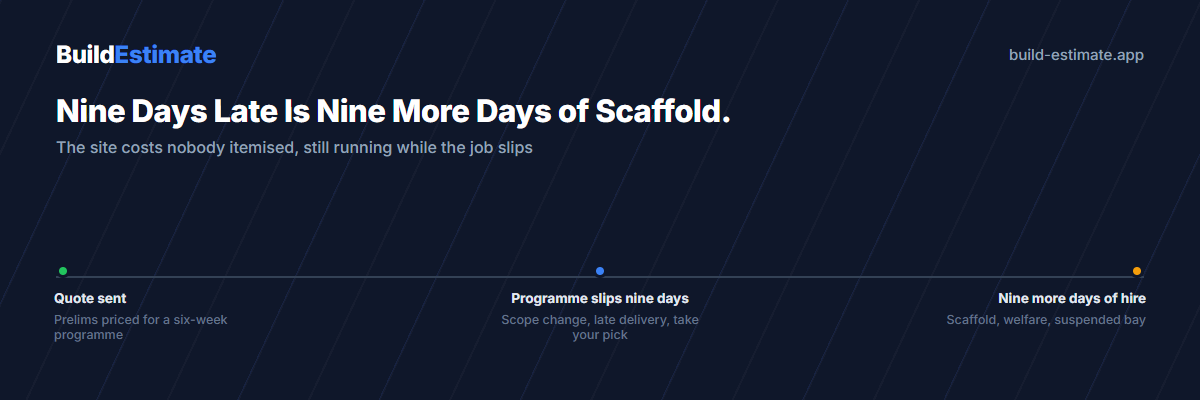
Every quote prices the work. Fewer price the cost of turning up, setting up, keeping the site legal and putting it back afterwards. Those are your preliminaries, and on small jobs they're usually paid for out of your own margin without anybody deciding to do that.
What prelims actually are
Preliminaries are what it costs to run the job rather than build it. A commercial tender has a whole section for them. A domestic quote for a loft conversion normally has none, because the estimate was built up trade by trade: so many metres of stud, so many hours of first fix, materials plus a margin.
Nothing in that method has a line for the skip, the toilet, the two hours a week you spend on site not laying anything, or the fortnight the scaffold stands there after the roof is finished. So those costs still happen. They just come out of the margin on the measured work.
The ones that go missing
From quotes we see, in rough order of how often they're left out: welfare, waste, protection of the client's finishes, site clean at the end, permits, temporary power and water, deliveries and storage, and your own supervision time.
Scaffolding usually does get priced, because somebody sends you an invoice for it. That's the pattern: costs with an invoice attached get remembered, costs that are just your time or your van don't.
Add one more if the building went up before 2000: the asbestos survey. It usually falls to the client, but if your quote doesn't show it as a provisional sum or a clear exclusion, the first either of you hears about it is a stopped job. Our guide to asbestos surveys before refurbishment work covers which survey a strip-out actually needs.
Welfare is not optional, including on domestic work
Schedule 2 of CDM 2015 sets out what has to be available to anyone working on your site. It's more specific than most people expect.
Sanitary conveniences, kept clean and lit. Washing facilities near them, with running hot and cold water, soap, and something to dry hands with. A supply of drinking water, with cups unless it comes out as a jet. Somewhere to change and lockers for personal clothing where the work needs special clothing. And rest facilities: seating with backs, tables, a means of boiling water, and somewhere for a pregnant worker to lie down.
Regulation 15 puts that duty on the contractor. On a house extension it usually gets met by agreement with the client, their downstairs loo and their kettle, and everyone is happy until the client isn't. If that agreement is what you're relying on, write it into the quote. If it's a bare site or an empty property, you're hiring a welfare unit, and that's a real weekly cost you need to have priced. We've covered the wider duties in our guide to CDM regulations on domestic jobs.
The permit trap
This one catches people who've only worked on driveways and private land.
You often can't get a skip permit yourself. Barking and Dagenham, for example, only issues them to skip contractors registered with the council, not to residents and not to the builder. Registration costs £390.29 and needs a public liability certificate for at least £5,000,000 plus a valid waste carrier licence. So the permit comes through your skip supplier, on their timetable, and it's their name on it.
Parking is worse, because the meter runs. Kensington and Chelsea charge, from 1 April 2026, £82 per bay per day for the first five days, £123 a day from day six to day 42, and £164 a day after that. Need it at short notice, meaning inside five working days, and there's a £408 one-off fee on top. Suspend two bays for a three-week strip-out and you are into four figures before a single skip arrives.
Boroughs differ enormously and some charge nothing at all. That's exactly why it belongs in the quote as its own line with the borough named, rather than absorbed into a day rate you set before you knew the postcode.
The ones that run per week
Split your prelims into fixed and time-related, because they behave completely differently when the job slips.
Fixed costs happen once: setting up, the final clean, making good the driveway. Time-related costs run for as long as you're there: welfare hire, scaffold hire beyond the included period, bay suspension, storage, and your own supervision. A two-week overrun doesn't just delay your next job. It quietly adds two weeks of every hire agreement you have standing on that site.
That's the number to have in your head during a variation conversation. If a client's change adds nine days to the programme, the cost isn't only the extra work. It's nine days of scaffold, welfare and parking, and if you haven't identified those as time-related in the original quote, you'll struggle to charge for them later. Our guide to pricing variations goes into how to word that.
A percentage, or an actual list
Plenty of estimators carry prelims as a percentage of the works value. It's quick, and on repeat work of a familiar type it's defensible.
On one-off domestic jobs it's where margin goes to die. The percentage was calibrated on a job with easy parking and a client who let you use the loo, and now you're on a terraced street with a suspended bay and a chemical toilet. The percentage doesn't know that. A list does.
Our rule of thumb: anything running longer than a week gets its prelims itemised. Under that, a percentage is fine, as long as you've checked the two things that vary most between jobs, which are access and waste.
Putting them in the quote without losing the job
Don't hide them. A separate, named section reads as professional and gives you something to point at when the programme changes. Buried in an inflated day rate, the same money reads as expensive, and you can't defend a number you never explained.
Name the borough and the assumption behind each cost. "Skip permit and one bay suspension, LB Newham, 10 days" is a line a client can check. "Site costs" is not, and it's the first thing they'll ask you to cut.
State what you've assumed the client provides. Use of a WC and a socket, or not. Where materials can be stored. Whether the drive is available. Every one of those becomes a variation if it turns out not to be true, and variations are easier when the original assumption was written down.
Common questions
What counts as preliminaries in a construction quote?
Everything needed to run the site rather than build the work: welfare facilities, waste removal and skips, permits and licences, scaffolding and access, temporary power and water, protection of existing finishes, storage, supervision time, insurance and the final clean.
What percentage should preliminaries be?
Published ranges vary widely and none of them know your site. For jobs over a week, price the actual items instead. A percentage carried over from a previous job is the most common way builders end up funding welfare and parking themselves.
Do I have to provide welfare facilities on a domestic extension?
Yes. Schedule 2 of CDM 2015 applies to construction work generally, and regulation 15 puts the duty on the contractor. In practice it's often met by arrangement with the householder, but that arrangement should be written into the quote rather than assumed.
Can I get a skip permit myself?
Often not. Many councils, including Barking and Dagenham, issue permits only to skip contractors registered with them, with a registration fee, £5m public liability cover and a waste carrier licence required. In those boroughs the permit comes through your skip supplier.
How much does suspending a parking bay cost?
It depends entirely on the borough. Kensington and Chelsea charge £82 per bay per day for the first five days from 1 April 2026, rising to £123 and then £164 for longer suspensions, plus £408 if you apply at short notice. Other boroughs charge a fraction of that, and a few charge nothing. Check before you quote.
Should preliminaries be shown separately to the client?
Show them. A named line with the assumption behind it is easier to defend than the same money hidden inside a higher rate, and it gives you a reference point when the programme or the scope changes.
What is the difference between fixed and time-related preliminaries?
Fixed prelims happen once regardless of duration, like setting up and the final clean. Time-related prelims accrue for every week you're on site, like welfare hire, scaffold hire and bay suspensions. Only the second group grows when the job overruns.
Do preliminaries apply to small jobs?
They exist on every job, priced or not. On a two-day job they might be a skip and an hour of clean-up. The question isn't whether they're there, it's whether anybody charged for them.
Before you send the next quote
- Check the postcode for parking restrictions before you set a price, not after you win the job.
- Ask who provides the WC, the power and the storage, and write the answer into the quote.
- Separate the prelims that run weekly from the ones that happen once.
- Give the final clean a line of its own. It's the item most often done for free.