Asbestos: The Survey You Need Before You Start
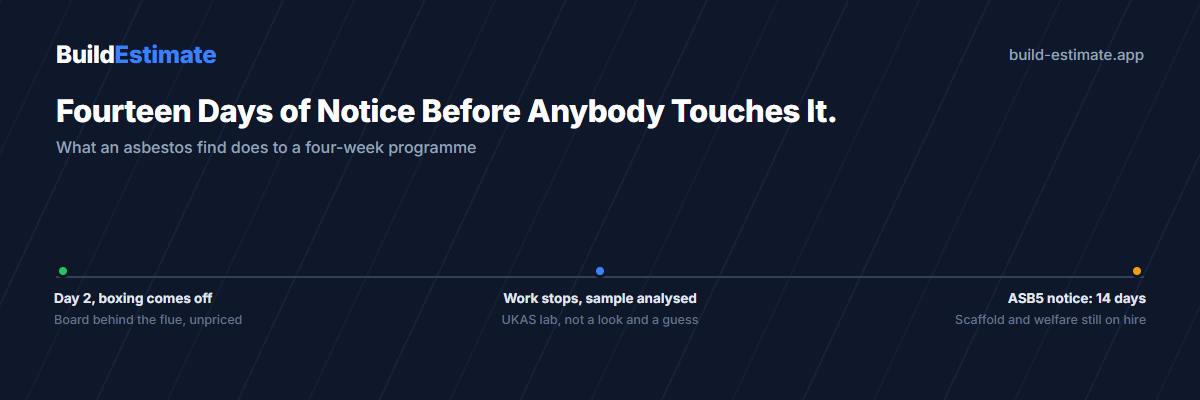
A 1974 semi, a kitchen and utility knock-through, four weeks priced. Day two, somebody pulls down the boxing round the boiler flue and one of the lads says that board looks like Artex's uglier cousin.
Now what? Because from that moment you are either stopping, or you are committing an offence.
The rule, in one sentence
Regulation 5 of the Control of Asbestos Regulations 2012 says an employer must not carry out demolition, maintenance or any other work that exposes or is liable to expose employees to asbestos unless one of two things is true.
Either you have done a suitable and sufficient assessment of whether asbestos is present or liable to be present, what type it is, what material it is in and what condition it is in. Or, where there is doubt, you assume asbestos is there, assume it is not chrysotile alone, and work to the rules that follow from that.
Read it again and notice the order. The assessment comes before the work. Not before the removal, not before the notifiable bit. Before the work.
The year that decides it
HSE put the line at 2000. Their own guidance says asbestos may be part of any commercial or domestic building built or refurbished before that year.
That covers most of the housing stock you quote on. It covers the 1930s semi, the 1965 maisonette, the 1998 office fit-out. It covers a 2015 kitchen if the boards behind it went in during 1981.
So "is it pre-2000" is a question that belongs on your first site visit, alongside the tape measure. It costs nothing to ask and it changes what you write down.
Two surveys, and only one is enough for you
There are two, and people mix them up constantly.
A management survey is what a building owner has for day-to-day occupation. It finds what could be disturbed during normal use, and it supports the asbestos register a dutyholder has to keep under regulation 4. It is not destructive. It does not look inside the walls.
A refurbishment and demolition survey is the one you need. It is intrusive on purpose: it goes into the fabric, behind boxings, under floors, into voids, looking for the material a management survey was never designed to find. HSE are blunt about the consequence, which is that the area has to be vacated while it is done and then certified fit for reoccupation afterwards.
Handing you a management survey and calling it done is the single most common way this goes wrong on a domestic job. The client is not being clever. They genuinely think a survey is a survey.
Who is supposed to arrange it
Two different duties, sitting on two different people, and the confusion between them is why nobody books one.
Regulation 4 puts the duty to manage asbestos on whoever is responsible for maintaining non-domestic premises. That is the landlord or the owner, and it is the source of the asbestos register you should be asking for on any commercial job.
Regulation 5 is on you. It applies to you as an employer about to expose your own people, and it does not lapse because the client forgot, because it is a domestic job with no dutyholder, or because the client swore blind there is nothing in it. If you start without the assessment, you are the one who has failed regulation 5.
On a domestic project with more than one contractor, the CDM duties that would sit with the client transfer to the principal contractor anyway, which we have covered separately. The practical upshot is the same. This lands on you.
Who can do it
Not you, and not your surveyor mate with a camera.
HSE set out what competence looks like here: technical knowledge of the work, relevant training and practical experience, a working quality management system, and independence, impartiality and integrity. They strongly recommend using an organisation accredited by UKAS. Sampling and analysis are narrower still, because only a trained analyst from a UKAS-accredited lab can confirm whether a material actually contains asbestos.
When the report comes back, read it rather than filing it. HSE tell dutyholders to check for caveats that were not disclosed up front, clear diagrams, evidence that every room was actually accessed, and sampling in proportion to what was inspected, which is usually one or two samples per area. A survey with a caveat saying the first floor was not accessible is not a survey of the first floor, and if you price the job off it you own the gap.
What it does to your programme
Once asbestos is confirmed, the question is which of three categories the work falls into, and they have very different effects on a start date.
Licensed work is the heavy end: sprayed coatings, pipe lagging, asbestos insulating board, loose fill. It needs a licensed contractor, and all licensable work has to be notified to the enforcing authority on form ASB5 at least 14 days before it starts.
Fourteen days. Not fourteen working days of your programme, fourteen days of nothing happening on that element while the notice runs. If you priced a four-week job and this lands in week one, you have just lost half the programme and every day of scaffold, welfare and plant hire that goes with it. Those are preliminaries, and they keep running whether anybody is on site or not.
Notifiable non-licensed work sits in the middle. No licence, but it still has to be notified, and it carries medical surveillance and record-keeping duties. Non-licensed work at the bottom, typically asbestos cement, still needs training, controls and proper disposal.
The control limit that decides a lot of this is 0.1 fibres per cubic centimetre averaged over four hours, with a separate 0.6 f/cm³ over ten minutes for lower-risk material like asbestos cement. You are not measuring that yourself. It is worth knowing the number exists, because it is what a risk assessment is arguing about.
Finding it mid-job
Stop. That is the whole instruction and it is worth saying plainly because the instinct is to keep going.
Not sweep it up, not bag it, not get it out before the client notices. Stop, keep people out of the area, and get it identified. What you have at that point is a variation in the proper sense: a change to the works nobody could price at tender, with a cost and a time effect that both need agreeing in writing before anybody goes back in.
The difference between a builder who handles this well and one who does not is entirely about the fifteen minutes after the discovery.
What the courts actually do
In March 2026 HSE prosecuted over asbestos disturbed on a demolition site in Cannock. Sentencing on 6 March: the demolition contractor, Sohan Group Limited, was fined £74,900 with £3,658.14 costs and a £2,000 surcharge. Maize Metals Limited was fined £13,400 with £1,359.51 costs and a £2,000 surcharge. A site manager received a 26-week suspended sentence, a three-month electronic curfew, a five-year director disqualification and £5,899 in costs. The HSE inspection that started it was in September 2023, so the case ran for two and a half years.
The inspector's line in the HSE release is the one to keep: asbestos is a Class 1 carcinogen known to kill around 20 tradespeople each week. HSE put the total at over 5,000 deaths a year in Great Britain.
None of those fines were for the survey. They were for what happened after nobody did one.
How to write it into a quote
Three ways, and the right one depends on how much you know when you price.
If the survey exists, price the job off it and reference the report by date in your quote. That is the clean version.
If it does not exist and the building is pre-2000, the honest structure is an exclusion plus an allowance. Exclude asbestos survey, removal and disposal from the quoted sum, state clearly that the price assumes no asbestos-containing materials are present, and carry a provisional sum for the survey itself so the client is not surprised by the first invoice.
If you are quoting a demolition or a full strip-out, do not price at all until the refurbishment and demolition survey is in. You are not being awkward. You are being asked to price work whose scope is unknown, and the client's alternative is to find out later at a variation rate.
We are deliberately not giving you a figure for what a survey costs. Nothing HSE publishes carries one, and every number we could find came from a company selling surveys, which makes it marketing rather than a benchmark. Get two or three quotes for the building in front of you.
One line in the quote that saves arguments: if asbestos-containing materials are found, work in the affected area stops until a licensed or appropriately trained contractor has dealt with them, and both the cost and the programme will be adjusted.
Common questions
Do I legally need an asbestos survey before building work?
You need an assessment. Regulation 5 of the Control of Asbestos Regulations 2012 says you must not do work liable to expose your employees to asbestos unless you have carried out a suitable and sufficient assessment of whether it is present, what type it is, what material it is in and what condition it is in, or you assume it is present and work accordingly. A refurbishment and demolition survey is the practical way of satisfying that, and it is the only survey type that looks inside the fabric.
What is the difference between a management survey and a refurbishment survey?
A management survey covers normal occupation and supports the asbestos register a dutyholder keeps under regulation 4. It is not intrusive and it does not look inside walls. A refurbishment and demolition survey is deliberately destructive, goes into the building fabric, and HSE say the area has to be vacated while it is done and then certified fit for reoccupation. Only the second one is any use for pricing a strip-out.
Does this apply to houses?
HSE say asbestos may be in any building, commercial or domestic, built or refurbished before 2000. The regulation 4 duty to manage applies to non-domestic premises, so a private house has no dutyholder and no register to ask for. Your own regulation 5 duty as an employer does not change because the building is somebody's home.
Who pays for the survey?
Commercially it is negotiable and it usually falls to the client, since it is their building and the survey outlives your job. What is not negotiable is that the work does not start without the assessment. Price it as a provisional sum in the quote rather than absorbing it and hoping.
How long does asbestos work delay a job?
Licensable work has to be notified to the enforcing authority on form ASB5 at least 14 days before it starts, so a fortnight is the floor for that element before you add the removal itself. Notifiable non-licensed work also has to be notified. Non-licensed work such as asbestos cement can often be handled by a trained operative without that wait.
Can I remove asbestos myself?
Some of it, some of the time, with training, controls and proper disposal, and asbestos cement is the usual example. Coatings, pipe lagging and asbestos insulating board need a licensed contractor. If you cannot say with certainty which category a material falls into, you do not have the assessment the regulation requires and you should not be touching it.
What do I do if I find asbestos mid-job?
Stop work in that area and keep people out. Do not clean it up or bag it. Get it identified by a UKAS-accredited analyst, then treat it as a variation with a cost and a time effect agreed in writing before anybody goes back in.
Can I just exclude asbestos in my terms and carry on?
An exclusion protects your price. It does not protect you from regulation 5, which is a duty on you as an employer and cannot be contracted away to a client. Put the exclusion in the quote, and still do not start without the assessment.
Pricing it properly
Asbestos is the sort of thing that turns a profitable four-week job into a break-even six-week one, and it does it through hire, welfare and overrun rather than through the removal invoice.
BuildEstimate prices a job line by line, keeps provisional sums and exclusions visible on the quote the client signs, and turns a variation into a new priced line rather than a text message you will argue about in November. It is £20 a month, or £220 a year with one month free, and there is a 7-day free trial with no card required.
Price a job in BuildEstimate →