CDM Regulations 2015: What Small Builders Owe Domestic Clients
Two builders take on similar jobs the same week. One is fitting a new kitchen for a homeowner in Romford. The other is doing a loft conversion with a second-fix electrician and a plasterer both on site at once. Neither job feels like it needs a health and safety consultant. Under the Construction (Design and Management) Regulations 2015, one of them might.
CDM 2015 applies to every construction project in Great Britain, domestic or commercial, big or small. Most small firms have heard of it and assume it's for housebuilders and civil engineering outfits with a site manager and a Portakabin. It isn't. It covers a bathroom refit as much as a new-build estate, and for domestic work the regulations do something people rarely expect: they hand the client's own legal duties to you, the contractor, without either of you signing anything to say so.
This is a practical rundown of what that actually means for a small firm working on someone's home, not a substitute for reading the regulations yourself on a project that worries you.
What CDM 2015 covers
The regulations set out duties for everyone involved in a construction project: clients, designers, principal designers, contractors, principal contractors and workers. The aim is straightforward even if the paperwork isn't: health and safety planned in from the start rather than bolted on once something's gone wrong. It applies to "construction work," which HSE defines broadly enough to include most of what a small building firm does: building, altering, converting, repairing, maintenance, demolition. A loft conversion counts. A full rewire on its own generally doesn't, but bring a builder in to open up walls for it and you're back in scope.
Domestic clients don't carry their own duties
A domestic client is anyone having work done on their own home, or a family member's, that isn't part of a business. Ordinarily under CDM, the client carries a set of duties: making suitable arrangements for managing the project, providing information to the people doing the work, and making sure welfare facilities are in place. A homeowner doesn't do any of that, and the regulations don't expect them to.
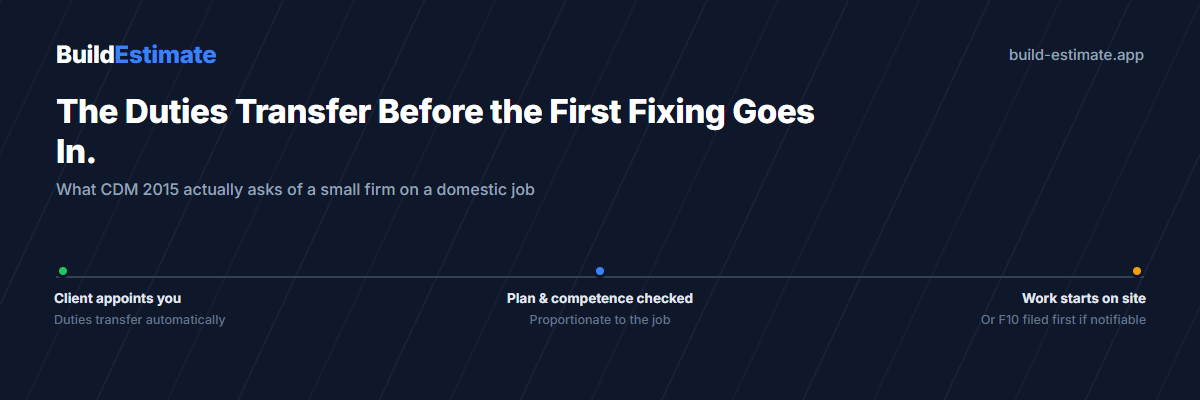
Instead, those duties transfer automatically. On a job with a single contractor, they land on you. On a job with more than one contractor working at the same time, they land on whichever one is the principal contractor, usually the one in overall control of the work, not necessarily the one who turned up first. Nobody has to ask for this. It happens by default the moment the project starts, whether you've read the regulations or not.
There's one way round it. If the client has appointed an architect or designer to run the project and that designer agrees in writing to take on the client duties as principal designer, the duties sit with them instead. Without that written agreement, HSE's own guidance is blunt: the duties default to the principal contractor regardless of who's actually coordinating the design. A verbal understanding with the architect isn't enough. It has to be in writing.
Single contractor versus more than one
The number of contractors on site at the same time changes what you have to do, so it's worth being precise about it. One contractor working alone, even with subcontracted trades brought in and out under your instruction, generally keeps things simple: you take on the client duties, plan the work, and manage your own site safety, which for most small jobs is close to what you'd do anyway.
Bring in a second contractor working independently, rather than as your subcontractor, and the picture changes. Now you need a principal contractor and, if there's design work beyond basic drawings, a principal designer too. On a domestic loft conversion with a separate structural engineer and a separate electrical contractor both instructed directly by the homeowner rather than by you, that threshold can be crossed without anyone announcing it. Worth working out at the quote stage, not halfway through the job when someone asks who's supposed to be running site safety.
What you actually have to produce
For most domestic jobs, this isn't as heavy as it sounds. A construction phase plan is required on every project regardless of size, but the regulations are explicit that the effort should be proportionate to the risk. For a straightforward kitchen refit, that can be a short document covering who's on site, what the main hazards are, and how you're managing them. It doesn't need to run to twenty pages.
On anything built before 2000, asbestos belongs on that list of hazards, and the plan should say how you know whether it's there. Our guide to the asbestos survey you need before you start explains which survey answers that question and which one doesn't.
What it does need is to exist before work starts, not get written up afterwards because someone asked for it. HSE inspectors can and do ask contractors to produce theirs, and "I know it in my head" isn't a document.
When you have to notify HSE
Most domestic jobs never reach this point, but it's worth knowing the number rather than guessing. A project must be notified to HSE using an F10 form if it will last longer than 30 working days and have more than 20 workers on site at once, or if it will run to more than 500 person-days of work in total. A person-day is workers multiplied by days: ten people for fifty days is 500, same as five people for a hundred.
A single extension with two or three tradespeople rarely gets close. A larger domestic project with several trades stacked up over a long build can. If you're not sure, it takes ten minutes to work out the person-days on a project and check against the threshold before you assume it doesn't apply to you.
| Situation | Who holds client duties | Notify HSE? |
|---|---|---|
| One contractor, own subcontractors underneath | You | Only if >30 days & >20 workers, or >500 person-days |
| More than one contractor, no principal designer agreement | The principal contractor | Same thresholds, checked across the whole project |
| Designer has a written agreement to take client duties | The principal designer | Same thresholds |
Competence isn't a form, it's a real duty
CDM 2015 requires contractors to have the skills, knowledge and experience to do the work safely, and to make sure anyone working for them does too. In practice this means keeping evidence: training records, CSCS cards, references from past jobs, membership of a trade or professional body, or a third-party scheme like an SSIP assessment if a client asks for one. None of this is exotic. Most established firms already have most of it. The point is that it needs to be kept somewhere findable, not assembled from memory if HSE or a client ever asks.
Getting it wrong
HSE has real enforcement teeth on construction sites: improvement notices requiring a fix within a set time, prohibition notices that stop work immediately where there's a serious risk, and prosecution for the worst breaches, with fines that aren't capped and, in serious cases, custodial sentences for individuals. Most small domestic jobs never see an inspector. The ones that do tend to be picked up on complaints, accidents, or a site that looks obviously wrong from the street. A construction phase plan that doesn't exist, or welfare arrangements nobody thought about, are exactly the kind of gap an inspector finds in the first five minutes.
Where this fits on the quote
None of this changes what the job is worth, but it does change what you need to account for before you price it: time to write a proportionate construction phase plan, a decision on who's principal contractor if a second trade is coming in independently, and evidence of competence kept somewhere you can actually find it. BuildEstimate won't write your safety plan for you. It will let you build these considerations into a job as a proper line, rather than something remembered halfway through and never priced in at all. See our guides on estimating a job and writing a construction quote for the rest of getting a domestic job priced properly.
Prefer to see the numbers first? View pricing: it is £20 per month or £220 a year, with a 7-day free trial and no card required to start.
FAQ
Does CDM 2015 apply to a small domestic extension or a single-room refit?
Yes. CDM 2015 applies to construction work regardless of size, including small domestic jobs. What changes with the size of the job is how much paperwork is proportionate, not whether the regulations apply at all. A kitchen refit still needs a construction phase plan, even if it's a short one.
Do I need to notify HSE for a typical domestic job?
Almost never. Notification via an F10 form is only required if the work will last longer than 30 working days with more than 20 workers on site at once, or if it totals more than 500 person-days overall. A standard extension with two or three trades rarely gets close. A large domestic project with several trades stacked up for months can, so it's worth doing the sum rather than assuming.
What happens if I don't have a construction phase plan and HSE asks for one?
It's a genuine breach, not a technicality. HSE inspectors can request the plan on site, and not having one is exactly the kind of gap that turns a routine visit into an improvement notice. The plan doesn't need to be long for a domestic job, but it does need to exist in writing before work starts, not get written up afterwards because someone asked.
Who is the principal contractor if I bring a separate electrician onto a domestic job?
It depends on how they're engaged. If you instruct and pay the electrician as your own subcontractor, you generally stay as the sole contractor and the duties stay with you. If the homeowner appoints the electrician directly, alongside you, that's more than one contractor working independently, and the client's duties fall to whichever of you is in overall control of the work.
Can a homeowner keep the client duties themselves instead of passing them to me?
Not by default, and not just by saying so. For a domestic client, the duties transfer automatically to the contractor, or to the principal contractor on a multi-contractor job. The only way round it is a written agreement with an appointed principal designer taking those duties on instead. A verbal arrangement or an assumption that the homeowner is handling it isn't enough.
Does CDM 2015 apply if the property is a rental rather than the client's own home?
The domestic client exemption is about the client, not the building. It covers work an individual has done on their own home, or a family member's, outside of any business. A landlord commissioning work on a let property is acting as a business client, so the full commercial client duties apply, not the domestic transfer rules covered here.
What counts as evidence of competence under CDM 2015?
Anything that shows you and anyone working for you can do the job safely: training records, CSCS cards, references from completed jobs, membership of a relevant trade body, or a third-party scheme such as an SSIP assessment. Most established firms already hold most of this. The requirement is to keep it somewhere you can produce it, not to assemble it from memory if it's ever asked for.
The regulations don't care whether a job is a kitchen or a new-build. What changes the level of paperwork is the number of contractors, the length of the job, and how many people are on site at once. Work those out honestly at the quote stage and the rest tends to follow without a fight.